
Islam isn’t just a religion that teaches people to pray, fast, recite the Quran, or worship God alone. It’s much more than that.
To be a Muslim is to be someone who does what they can to promote the reformation (known as islah in Arabic) of society into one that is free, just, and equitable for everyone. Corruption or injustice of any form is something that Muslims should not tolerate.
- [7:29] Say, “My Lord has commanded the justice. And maintain your devotion at every masjid, as ones who make sincere the religion to Him. You will return, like how He originated you.”
- [13:29] And the ones who break God’s pledge after its covenanting and sever what God has commanded to be joined by it, and commit corruption in the earth, for those is the curse, and for them is an evil home.
What is justice, and what is injustice? The Quran discusses many, many specific examples, but it all roughly boils down to the following definition: don’t do something to others that you do not want others to do to you.
- For example, don’t make fun of someone for missing teeth when you don’t want to be made fun of for losing an arm.
- Don’t steal someone’s $10,000 when you don’t want your $1,000,000 to be stolen.
- Don’t be greedy or stingy with your money when you don’t want others doing the same to you during a time of need.
- Don’t be rude and inconsiderate to others, if you don’t like receiving rudeness and inconsideration from others.
- Don’t corrupt the environment, which is public property, when you don’t want others corrupting your private property.
- Do not expel people from their native lands, when you don’t want to be expelled from yours.
- Do not engage in economic exploitation, as you don’t want others unfairly exploiting your time, labor, and wealth.
The Quran specifically discusses each of these injustices (mockery/ridicule, theft, greed, rudeness, environmental corruption, forced expulsions and displacement from native lands, exploitation of others) and much more, but all of that essentially boils down to the golden rule that is probably found in all major religions: treat others the way you want to be treated, and do not treat others in a way that you don’t want to be treated.
Moreover, a city or town in which at least one person is a reformer is one that is protected from being totally wiped out and destroyed by God.
- [11:88] He said, “O my people, have you not seen that I am upon clear proof from my Lord, while He has provided me with good provision from Himself? And I do not intend to differ from you in what I forbid you from. I intend not but the reformation, however much I have been able. And my success is not but with God. Upon Him I put my trust, and to Him I have turned.”
- [7:56] And do not cause corruption in the earth after its reformation…
- [11:117] And your Lord would not annihilate the towns unjustly, while their people are reformers.
So why does God in the Quran have so many verses about reforming both one’s own self and reforming the way people behave with one another? Why not just teach someone the five pillars and let everyone else figure out the rest?
Why are there verses in the Quran telling people how to treat spouses, slaves, neighbors, guests, parents, prisoners of war, and beggars, whether Muslim or non-Muslim?
Why does the Quran teach people how and when to conduct war (that is, not over things like property and resources, but for the sake of defending from aggressors, or rescuing the oppressed)?
Why does the Quran teach how to trade with one another or how to transact loans (only mutually approved transactions, no bribery or usury or gambling, fair compensation, no defrauding, record your transactions, minimize exploitation, minimize wealth disparities, and more)?
Why does the Quran teach people an inheritance system and a Zakat system that makes it very hard to unevenly distribute wealth over several generations?
Why does the Quran encourage travelling the earth and discovering how God created the world (which is an invitation to study the fields of science and conduct observations and experiments to find out the answer)?
Why does the Quran provide guidelines about how to form a system of government? See this article about the details.
The answer is that God doesn’t only care about people worshipping Him. Equally as important to Him is helping us reduce our own self-inflicted suffering and injustices as a society, whether physical, verbal, emotional, economic, and more. We humans are our own worst enemy.
Not only that, but one’s spiritual connection with God grows when doing good things for other people. We know this because altruism makes us feel great and raises our spirits up. But we become spiritually dead or numb when committing and tolerating bad deeds.
- One can imagine it as either keeping the soul, the real person inside your body, either well-fed or starving, depending on how you live your life.
Sure, God can just “snap a finger” and make sure everyone does nothing wrong automatically, and life would be fantastic as a result, but He wants to see if we are capable of coming together ourselves and make whatever changes we need to minimize our man-made or self-inflicted problems.
- [13:11] For him are followers, from before him and behind him, who guard him by God’s command. Indeed, God does not change what is with a people until they change what is with themselves…
- [30:41] Corruption has appeared in the land and the sea due to what the hands of the people have earned, for He may let them taste some of that which they have done, so that they may return.
So this is why Muslims must always examine any major institution of society, whether economic, political, environmental, civil, educational, agricultural, healthcare, and others, and always look for how they can reform those systems to make them as beneficial, fair, ethical, and free of corruption as humanly possible.
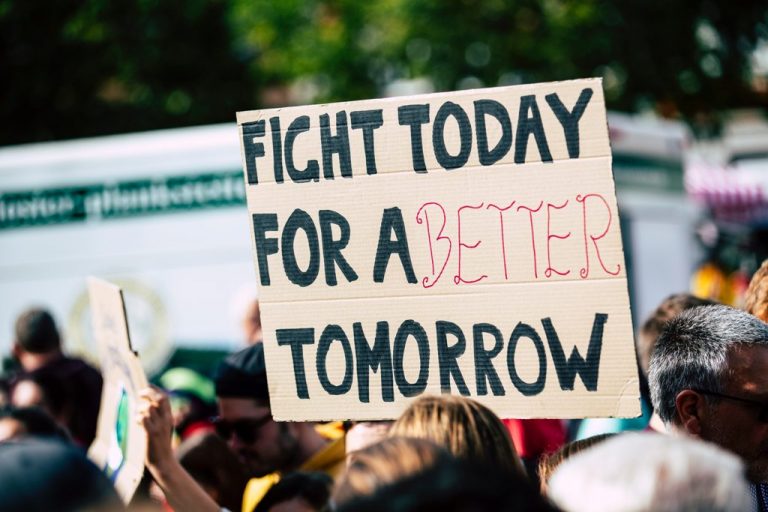
If this post can be shortened down to a few words, let it be this: activism and doing whatever you possibly can to make the world a better place for all to live is a serious religious duty for the Muslims.
Therefore, this post serves as a “Reforms Corner” or “Reforms Center” for this mosque. New articles discussing reformation ideas for the major sectors of society will be linked to this post periodically. It is our hope that this Reforms Corner will serve as an inspiration for activists around the world to advocate for change and reform wherever it is needed.
Leave a Reply