
Salaamun alaykum, dear readers!
The traditional understanding of a messenger according to most Muslims is one who receives a new scripture, and the traditional understanding of a prophet is one who is sent to teach and judge by the scripture given to a previous messenger.
So according to the traditional school of thought, all messengers are prophets because they all have to teach and judge by their own scriptures, but not all prophets are messengers because some prophets are not given their own scripture.
- Consequently, Muhammad is believed to be the final messenger because the Quran says he is the final prophet, and this definition does not allow a messenger who isn’t a prophet to exist.
But actually, the Quran says the exact opposite. Prophet Muhammad is the final prophet, but not the final messenger.
The Quran says in extremely clear terms that there will be a messenger who comes after Muhammad, and that messenger will not be a prophet himself.
In verse 3:81, it says that God took a covenant from the prophets, that they all should pledge their support and belief in a messenger who will one day come to them, as one who will confirm their scriptures. All the prophets accepted this covenant.
- [3:81] And when God took the covenant of the prophets: “Definitely, this is what I will give you of Book and wisdom. Then a messenger will come to you (all prophets) as one who will confirm what is with you (the scriptures). Definitely, you (all prophets) shall indeed believe in him and support him.” He said, “Have you agreed and accepted that, My heavy responsibility?” They (all prophets) said, “We have agreed.” He said, “So bear witness, and I am with you among the witnesses.
- All prophets, without exception, took this covenant. Muhammad was a prophet, so of course he also took this covenant. That means he also agreed to support and believe in a messenger who is coming after him, just like how all the other prophets did.
Secondly, verse 33:7 confirms that prophet Muhammad took the same exact covenant as the other prophets. That means, just like the other prophets, he too agreed to believe in and support a messenger who will come after him.
- [33:7] And when We took from the prophets their covenant—including from you (Muhammad), Noah, Abraham, Moses, and Jesus, the son of Mary—and We took from them a stern covenant.
So there is no beating around the bush, it is a very clear Quranic guarantee that there is a messenger who comes after Muhammad, the final prophet.
So verse 3:81 defines a prophet as someone who is given a scripture, because it states that all the prophets (without exception) were given a scripture.
Also, verse 3:81 defines a messenger as someone who confirms, teaches, and judges by the scripture sent to a previous prophet, because it states that the messenger coming after Muhammad will be confirming all previous scriptures.
So according to the definition we are provided in verse 3:81, all prophets are messengers because they confirm, teach, and judge by their own scripture. But not all messengers are prophets because some messengers are not given their own scripture, but are sent to confirm previous scriptures.
Now someone might ask, “What about Aaron, the brother of Moses? He was a prophet, but he was not given a scripture, right?”
Yes, Moses was the one who directly received the Torah, but the Quran defines the recipients as both Aaron and Moses, not Moses alone. The responsibility of prophethood (delivery of the scripture) was given to both.
- [37:117] And We gave the two of them (Moses and Aaron) the clear Book.
- [21:48] And certainly, We definitely gave Moses and Aaron the Criterion, an illumination and a reminder for the servants.
Additionally, verse 3:81 says this future messenger will “come to” all the prophets. Of course, how can a future messenger meet prophet Muhammad and the other prophets when all the prophets are long dead?
- Logically, this can only happen when God takes up the soul of this future messenger to somewhere in the afterlife to meet the prophets, kind of like prophet Muhammad’s “mi’raj” (ascension) to the place where the lote tree was.
After this future messenger meets all the prophets, his soul must be sent back down to earth so that he can complete his mission that is stated in verse 3:81 (confirming the scriptures that all the prophets were given).
Verse 7:35 Suggests Future Messengers
Another proof that Muhammad is not the last messenger is that the Quran says in verse 7:35, while talking to “the Children of Adam” (all human beings, present and future) that if His messengers come to us, telling us about God’s signs, then we should listen to those messengers.
- [7:35] O Children of Adam, if messengers among you come to you, narrating upon you My signs, whoever then reveres and reforms, there will thus be no fear upon them, nor will they grieve.
Let us suppose that King Salman was the last king of Saudi Arabia, and he makes this announcement: “O Saudi people, if kings come to you one day to rule Saudi Arabia, you should listen to them.”
- Why would Salman say that other Saudi kings may possibly come after him if he was really the final king?
Likewise, God in verse 7:35 tells prophet Muhammad to say to the people: if messengers among the people come to them with God’s signs, then they must listen to those messengers.
- The word “if” in verse 7:35 means an event can possibly happen.
So why would God discuss in the Quran the possibility that messengers may come in the future, if prophet Muhammad was truly the last messenger?
The reason is because the prophet Muhammad is really the final prophet, but not the last messenger.
God’s Warning
The Quran also tells us not to be like the people of Joseph, who kept mocking and ridiculing him as a liar and a crazy person even after the clear signs were shown to them, until when he died and they said there will never be another messenger to come after him.
- [40:34] And certainly, Joseph definitely came to you before with the clear proofs, but you had not ceased—in dissent from what he came to you with—until when he died. You said, “God will never produce another messenger after him.” Like that, God sends astray whoever is an excessive doubter.
So God uses verse 40:34 to tell the people not to say that any messenger is the “last messenger” without evidence. This applies to the prophet Muhammad. God calls whoever does this kind of act an “excessive doubter”.
Disclaimer
Now, before we continue, it is important to warn you that if you are a Muslim, but you do not believe that the Quran alone must be followed, then you may not yet be ready to learn the identity of the messenger whom the Qur’an said is coming after prophet Muhammad.
- That is because this messenger stated that God revealed to him that the Quran alone is the straight path, and he has thoroughly rejected the idea that the Sunnah of any human being (whether the prophet, or himself, or anyone else) is a source of Islamic law besides the Qur’an.
- If you follow Quran and Hadith, rather than Quran alone, then you will likely not want to accept this messenger.
- So before learning about the messenger who came after prophet Muhammad, it is extremely helpful to know how the Quran itself tells the Muslims to follow the Quran alone as a source of Islamic law, and not to follow Hadiths, Sunnah, ijma, or anything else outside of the Quran.
- Please click on this link to learn about the Quranic prohibition against following Hadith and any other secondary source of religious law after it.
Identity of the Messenger of the Covenant
So who is the Messenger of the Covenant that will come after the prophet Muhammad, according to verse 3:81?
The Quran contains the every detail and explanation that is needed guidance and mercy.
- [12:111] … It (Quran) has not been a fabricated hadith, but instead, it is the confirmation of that which is before you, the detailing of everything, and a guidance and mercy for people who believe.
- [16:89] …And We have brought the Book down to you as a clarification for everything, as well as guidance, mercy, and good news for the Muslims.
- [7:52] And certainly, We have definitely come to them with a Book which We detailed with knowledge as a guidance and mercy for a people who believe.
Knowing the identity of this messenger is an important detail needed for guidance. If God didn’t leave behind any detail in the Quran to help the people identify who this messenger is, then the Quran would be incomplete and missing a very crucial detail, thus contradicting the three verses listed above.
Therefore, the Quran tells the believers exactly how to identify this messenger.
The two arguments from the Quran that confirms this messenger’s identity involves the Quran’s 19-based mathematical composition, which you can read about here.
The Quran’s First Argument
In the Quran, specifically verses 74:30 and 74:31, God stated that there are 19 angels who guard over Hell.
The Quran then stated God assigned “their number” (the number of the angels, which is the number 19) to do five functions:
- Be a trial for the disbelievers,
- Produce certainty in the hearts of the People of the Book (Jews/Christians),
- Increase the faith of the believers,
- Remove the doubt from the believers and the People of the Book.
- Cause disbelievers to deny the number 19 by asking, “What did God really mean by this example?”
Here are the verses in full:
- [74:30] Over it (the Fire) are nineteen.
- [74:31] We have made not but angels as custodians of the Fire, and We have not assigned “iddatahum” (their number, which is the number 19) except as: (1) a trial for those who have disbelieved, (2) so that those who were given the Book may attain certainty, (3) and that those who believed may increase in faith, (4) and that those given the Book—as well as the believers—may not doubt, (5) and that the ones who have sickness within their hearts—as well as the disbelievers—may say, “What did God mean by this example?” Like that, God sends astray whom He wills, and guides whom He wills; none knows the soldiers of your Lord except He. It is but a reminder for humanity.
These verses are saying that the number 19 will one day prove the Quran as the truth, beyond all doubt, causing many Jews, Christians, and Muslims to achieve certainty (yaqeen), increase their faith (iman), and remove the doubts from their hearts. The number 19 will also serve as a test for the disbelievers.
The question now becomes: in what way will the number 19 prove to the world that Islam is the truth?
How exactly will the number 19 will use to remove all doubt, increase faith and certainty of the believers, and test the disbelievers?
This information is part of the “ghayb (unseen)” because only God knows the answer.
And the Quran states that God alone is the knower of the unseen, but if He wants to make some of the unseen known, He will only make it known to whichever messenger he wants, then it will be the job of the chosen messenger to spread this information to the world.
- [72-26:27] The Knower of the Unseen, but He does not make His unseen obvious upon anyone except a messenger of whom He has approved…
Take the prophecy of the smoke in Surah 44, for example. Nobody knows what will cause the smoke to happen on Earth, so this information is unseen (ghayb).
- If God wanted the people to know in advance exactly how the smoke will happen, then He would have made this information known to a messenger first, then this messenger would have made it known to the world.
The same thing applies to the number 19, the exact way that the prophecy of number 19 found in verses 74:30-31 will be fulfilled is part of the unseen (ghayb). Nobody knew how the number 19 will remove doubts from the Jews, Christians, and Muslims, and increase their faith and certainty, and be a test for the disbelievers.
- And if God wanted this unseen information to be known to the people, He would only make it known to a messenger whom He chooses, according to verse 72:26-27. Then this messenger must convey that information to the public.
That means the “first knower” of the Quran’s 19-based mathematical structure (which will fulfill the Quran’s prophecy of 19) must be a messenger of God.
- The first knower of the 19-based mathematical structure is Rashad Khalifa.
- Therefore, Rashad Khalifa is a messenger of God.
Okay, we now know that Rashad is a messenger of God, but how do we know that he THE Messenger of the Covenant mentioned in verse 3:81?
- A messenger of God would not lie about being the Messenger of the Covenant, so if Rashad insisted that he was the messenger of the covenant from verse 3:81, then that must be his identity.
- Rashad did in fact state that God told him how he is the messenger who fulfills verse 3:81, so we know for sure that Rashad is the messenger after Muhammad who is mentioned in verse 3:81.
The Quran’s Second Argument
The second argument is much more simple and straightforward than the first one.
The Quran in verse 3:81 stated that this messenger will confirm the scriptures that were sent down to all prophets.
Verse 74:31 says the number 19 will confirm the Quran (and by proxy, all the scriptures before it) as the truth, beyond all doubts.
So if you connect the dots and put 2 and 2 together, the Quran is saying that the messenger from verse 3:81 will confirm all the scriptures via the number 19, and the person who did that was Rashad Khalifa.
Who is Rashad Khalifa?
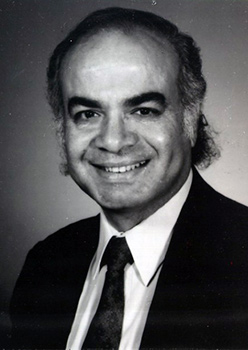
By all accounts, both public and private, he was a very nice guy. In fact, he is seemingly comfortable entrusting even his own car to strangers. Once, in the middle of a speech (the 1989 conference speech) when certain audience members had to go to the airport, he offered his car keys and asked if anyone in the crowd will take his car and drive them to the airport.
Now, the interesting thing about the Messenger of the Covenant is that he is not a Sunni, although he used to be a Sunni until the late 1970s.
He was the vice president of the Islamic Center of Tucson, but according to one of his closest companions, the Kurdish-American polymath Edip Yuksel, he started being increasingly more skeptical of Hadith since the late 1970s. He was finally kicked out of the Islamic Center when he rejected the punishment of stoning adulterers to death that is found in Hadith, saying that it contradicts the Quran.
- After getting kicked out, Rashad established his own masjid in 1979, known as Masjid Tucson, which was dedicated to practicing Islam from the Quran alone.
Rashad said God informed him of his messengership during 1980, by which time he was no longer a Sunni.
Rashad’s Honesty
Being a messenger does not guarantee that someone will always be correct in their personal opinions, and this is evident throughout the Quran amongst many of them, ranging from Abraham, to Moses, to Jonah, and even Muhammad.
This is why Rashad frequently made the distinction between “Rashad the human” and “Rashad the messenger”, saying that like everyone else, “Rashad the human” is required to follow “Rashad the messenger” and will be held accountable for any deviation from the message that God sent to “Rashad the messenger”.
To give an example, one of Rashad Khalifa’s personal beliefs since at most 1985, which many might disagree about, is that Gog and Magog (Yajuj and Majuj in Arabic) will appear in 1700 AH.
Why does he believe this? He said that God and Magog appear in the Quran in verse 18:94, which is 17 verses before the end of Surah 18. Gog and Magog also appear in verse 21:96, which is also 17 verses before the end of Surah 21.
So he believed this is the Quran’s sign that Gog and Magog will appear in 17 centuries after the Quran’s revelation, or alternatively, in the year 1700 AH in the Islamic calendar.
And he could have easily said that this was information which God directly revealed to him through Gabriel, if he was dishonest. But he did not say that.
Here is what Rashad Khalifa said during a January 1990 Quranic study session, one of his last recorded study sessions before he was killed later in that month:
“From the revelation of the Quran to the appearance of Gog and Magog is 17 centuries. Edip brought up the valid possibility that it may be 17 days before the end of the world, or 17 hours, 17 something. Obviously, it’s not relevant to us. If it is relevant, God will let us know.“
So Rashad could have easily justified his personal belief by saying, “This is what God told me.” But in 1990, he honestly stated that God didn’t tell him anything about when Gog and Magog will come, and that maybe if it is important, God will reveal information to him about it.
Thus, he indicates the idea that Gog and Magog will appear in the year 1700 AH is his understanding of the Quran, rather than something God directly revealed to him.
This is definitely a sign of his honesty, showing that he was really a messenger, and that he is not trying to lie to the people about being a messenger and make false claims about what he did or did not receive from God through the angel Gabriel.
Idolization of Rashad Khalifa Forbidden
Rashad Khalifa advised many times that obedience to the messenger is only obedience to his message, and not the messenger’s personal opinions or interpretations of the message. Rashad tells the people that while he is a messenger of God, it is their duty to disobey him if anything he says is not found in the Quran.
“We are not following Muhammad, we are not following Rashad Khalifa, we are not following any human being, and don’t let anybody tell you that. I don’t follow Rashad Khalifa, and you don’t follow Rashad Khalifa. We follow the words of God. We follow God, you and I.”
“And if Rashad Khalifa says anything on his own, we don’t listen to him. We can listen and use our own discretion. But we do not follow what Rashad is saying, we follow what God is saying, you and I.”
“You do not follow Rashad Khalifa. We do not follow Muhammad or Jesus. We do not follow any human being. We follow God, we know that.”
“And as you know, I’m the first one to tell you: if it is my opinion, if it is Rashad Khalifa, don’t follow him, because you’ll probably do the wrong thing. You must be sure you’re following God and following the word of God.”
“If I say anything that is not in the Quran, you tell me, ‘Get out of here.’”
“The criteria of obeying the messenger is: whatever he is saying must be in the Quran, must be backed up by what God is saying. If it’s not in the Quran, it is your obligation to disobey.”
“And we do not follow Rashad Khalifa or worship Rashad Khalifa, we follow what God says. If Rashad Khalifa says anything that is not in the Quran, you will be the first to tell him, ‘This is not in the Quran, why do you say that?’ And it is your duty not to obey him if it is not in the Quran.”
“We are going out of our way to destroy idols, not to make the idols. Our only god is God. And we have reached the conviction in our hearts that God alone possesses all power. We reached the conviction in our hearts that no saint, no prophet, no Muhammad, no Jesus, no Rashad Khalifa, no anybody, no one other than God can guide us.”
“We are people who know full well that no human being, certainly not Rashad Khalifa, can help you in anything except give you the message.”
“And we’ll go to any extent to make sure that we are following God and the word of God, and not following the words of any human being.”
“But we make it very clear, we follow Maalik al-Mulk, the Possessor of All Kingship. We follow only God. We follow only the word of God.”
Edip Yuksel has reposted email correspondence on his website, 19.org, showing that some followers of Rashad (while attacking Edip) have made claims that echo the Sunni-ism that Rashad was sent to denounce.
- They have stated because Rashad is a messenger, he is the one whom God appointed to explain the Quran. Therefore, Rashad’s explanations and interpretations of the Quran cannot contain any error, even if they are not based on direct revelations given to him from Gabriel.
- But logically, this is incorrect. Muslims are supposed to follow only the teachings that are directly revealed to the messenger (verse 7:203 and others). Nobody is responsible for adhering to the independent reasoning or personal understanding (ijtihad in Arabic) of any messenger, because that is elevating the messenger to the position of lawmaker besides God.
- While it was Rashad’s duty to teach and explain the Quran, being assigned a duty does not mean that a person will magically be error-free when carrying out this duty. God ordering the messenger to explain the Quran does not automatically guarantee that Rashad’s explanation will be 100% correct, beyond whatever information was directly revealed to him.
- The Quran reveals several duties to all believers (such as invite others to God’s path), but that doesn’t mean all believers will perfectly accomplish those duties without mistakes. The same applies to the duty to teach the Quran that God revealed to the messenger; a messenger simply being assigned the duty to teach and explain the Quran does not by itself guarantee that the messenger won’t make any mistakes when carrying out this duty.
- Therefore, unless otherwise specified as revelation by Rashad, anything he taught is from his ijtihad, which is his independent reasoning and understanding of the Quran, and his independent reasoning is not free of mistakes. The ultimate proof is in Quranic study audio number 36, available on YouTube, where Rashad stated that he lets others call him out on his mistakes, and even deliberately lets himself make mistakes at times, because his mission is to destroy the idols and not make new ones.
The Covenant Fulfilled
Rashad states that the covenant discussed in verse 3:81 was fulfilled on Dhul-Hijjah 3, 1391 A.H. Rashad mentioned in a 1988 speech that during this day, his soul was taken up by God to some unknown place to meet the prophets.
Rashad was told at the time that this event is currently not something he should be concerned about right now, but it is something that had to be done.
Then, he was shown a group of people and was informed that those were all the prophets God sent. They then came to him one by one and silently nodded their heads to show approval, then Rashad was sent back to Earth. Here is how he describes the event in Appendix 2 of his translation of the Quran:
During my Hajj pilgrimage to Mecca, and before sunrise on Tuesday, Zul-Hijjah 3, 1391, December 21, 1971, I, Rashad Khalifa, the soul, the real person, not the body, was taken to some place in the universe where I was introduced to all the prophets as God’s Messenger of the Covenant. I was not informed of the details and true significance of this event until Ramadan 1408. What I witnessed, in sharp consciousness, was that I was sitting still, while the prophets, one by one, came towards me, looked at my face, then nodded their heads. God showed them to me as they had looked in this world, attired in their respective mode of dress. There was an atmosphere of great awe, joy, and respect. Except for Abraham, none of the prophets was identified to me. I knew that all the prophets were there, including Moses, Jesus, Muhammad, Aaron, David, Noah, and the rest. I believe that the reason for revealing Abraham’s identity was that I asked about him. I was taken aback by the strong resemblance he had with my own family – myself, my father, my uncles. It was the only time that I wondered, “Who is this prophet who looks like my relatives?” The answer came: “Abraham.” No language was spoken. All communication was done mentally.
That incident, which took place during my pilgrimage to Mecca, was the fulfillment of Verse 3:81. That incident took place while I was fully awake, and I have shared the details with my family, my family of believers, and with my friends.
It is worth clarifying that there is a slight inconsistency with the date. Dhul-Hijjah 3, 1391 in Mecca is actually Wednesday, January 19, 1972. But Rashad remembers that day in Mecca as a Tuesday as per his 1988 Conference speech, given that his favorite Quran reciter at the time (Mahmoud al-Banna) used to recite the Quran live on radio at Tuesday mornings, and given that he says this happened while he was listening to al-Banna in the morning with his brother.
He recalls bringing 100 cassette tapes with him to Hajj, and telling his brother Atef (who eventually came to believe Rashad’s messengership) on that day to record al-Banna’s recitals with them.
Thus, it is likely the actual date in Hijri calendar is Dhul-Hijjah 2, 1391, or Tuesday January 18, 1972.
In fact, an Iranian newspaper published a picture featuring Rashad Khalifa and his mother in front of the Kaaba at the Hajj during January 1973. Here is the picture:
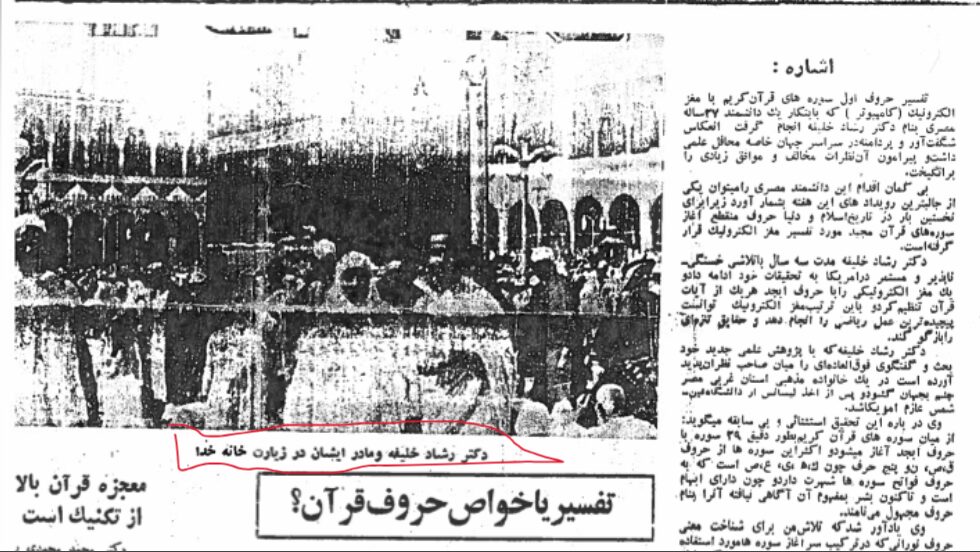
Someone who knows Farsi can probably understand what in the world this 1973 newspaper article is talking about, but the picture caption circled in red translates to, “Dr. Rashad Khalifa and his mother at the pilgrimage to God’s home.“
Thus, it is confirmed that Rashad regularly did Hajj with his family in the early 1970s. So there are two options: either Rashad met the prophets in January 1973, or he did so in January 1972, or he did in some other Hajj date in the early 1970s but is misremembering which one.
Rashad has previously admitted he is often not good at remembering dates. In a 1989 Friday Khutbah, Rashad admitted that he only recently found out he unveiled the Quran’s 19-based structure in 1974. He said that his son repeatedly insisted Rashad discovered the Quran’s 19-based structure in 1974, but Rashad didn’t believe him and thought his son was maybe a few years off the mark. When Rashad went through his old records, he found that his son was indeed right, that Rashad first unveiled his discovery in January of 1974.
The meeting with the prophets that Rashad experienced in 1972 marked the start of Rashad’s messengership, because the covenant in 3:81 says that a messenger will come to all past prophets as one who will confirm all previous scriptures. If Rashad came to them in 1972, then that was the day Rashad officially became a messenger, although he not told by God of his messengership at the time why this event took place.
He was not yet aware of the 19-based mathematical composition of the Quran in 1972, nor was Rashad made aware that he was a messenger until 1980.
In fact, it was in 1968 that he first started to study the Quranic Initials, and he states in his newsletter that at the time that while the number 19 was frequently noticed during his study of Quranic initials, his main finding at the time regarding the Quranic initials (which he published in his 1973 book Miracle of the Quran: Significance of the Mysterious Alphabets) was that the letters of each initial occurred in the highest proportions in the Surahs that they occurred compared to other Surahs. Out of the 114 Surahs, there are only 29 of them with Quranic initials which nobody understood the purpose or significance of. Surah 50 is one of them, and it is initialed with the letter “Qaaf”. Rashad found that Surah 50 has the highest proportion of the letter Qaaf relative to other letters than does the other Surahs of the Quran, meaning it has the highest percentage of the occurrence of the letter Qaaf in its verses out of all Surahs, and it’s the same for every initial except Surah 36 (initialed with the letters “Ya” and “Seen”), which contained the lowest proportion of those two letters out of all Surahs.
It wasn’t until after he published the book in 1973 that he realized that maybe there’s something else that needs further research. He noticed a recurring pattern of 19 at the time when analyzing the Quran but didn’t think much of it when writing the book.
But as he re-examined the data after publishing that book in 1973, he realized that the letters of the Quranic initials seemed to occur in the initialed Surahs in multiples of 19, and then finally in January of 1974, the fact that a vast and complex 19-based mathematical system pervades the entire Quran became a reality to him.
So, January of 1974 should be one of the most significant dates in Islamic history to have occurred, because that is when the Messenger of the Covenant in verse 3:81 fulfilled the prophecy in verse 74:31.
Rashad also stated that even during the year 1980, while he was told that he was a messenger of God, he wasn’t told that he was the Messenger of the Covenant mentioned in verse 3:81. The explanation of verse 3:81 didn’t come to him until God told him in 1988, according to Rashad.
He stated, in his speech at a 1989 conference, that in 1980 he was approached by the angel Gabriel who informed him that he was a messenger. But Rashad thought it was Iblis, the devil/satan, and invoked God’s protection and refuge against the devil.
But after some back and forth discussion, Gabriel assured him that he was not Satan, and conveyed that Rashad was God’s messenger and that verse 3 of Surah Ya Seen is addressed directly to Rashad.
Afterward, Rashad resolved to just teach God’s message (the Quran), believing that there was no need to make the announcement, and fearing the ridicule and backlash he would receive even from his own friends and family whom he loved very much and wanted to be with in the Hereafter. He said, “I went on my merry way, saying I will preach the word of God alone.”
So he never made a public announcement, and he even ignored repeated messages from God (through Gabriel) which encouraged him to announce his messengership. But 8 years later (April 1988), he was told by God that he was going to Hell and that someone else will be substituted in his place for the job. After sincere repentance, God accepted it and restored his position.
After that, Rashad announced his messengership during a Friday khutbah which was recorded on video on April 15, 1988, and the announcement is publicly available on YouTube.
He says in the October 1989 edition of his newsletter Muslim Perspective:
For eight years, I had maintained the same views as those who believe that an announcement was not necessary. I used to think: Why is the announcement necessary? Why not preach the word of God, uphold the word of God ALONE, and preach the worship of God ALONE, without announcing anything about the messengership? In those days of ignorance, I resisted making such an announcement. Finally, I was told that I was too coward to carry out the duties of God’s messenger. I was fired. It took a whole night of repenting, crying, apologizing, and pledging. When I reached a solid conviction that I must make the announcement, even at the cost of losing my own children and my best friends, I was restored. The following night, I spoke with my daughter during the pre-dawn meal of a Ramadan night, and I was trying to be as diplomatic as I could be. My daughter interrupted, “What are you trying to say, Dad? I knew all along that you are God’s messenger.” I received the same response from all the believers around me. They had known me for a long time, and they knew that I was not a crazy man. They realized that a person who lies about God or claims messengership falsely has to be a person who does not believe in God or the Hereafter; a person who does not expect to stand before God on the Day of Judgment to answer for his actions.
He stated that God accepted the repentance for his past 8 years of cowardice and restored his mission. He says in his May 1988 newsletter:
The recent announcement that I am God’s commissioned messenger to the world was NOT my idea. In fact, God Most Gracious has been immensely merciful towards me. Despite my cowardice for eight long years, God has accepted my repentance and my solemn pledge to (1) announce my identity as God’s messenger, and (2) never hesitate, hold back, or waver in declaring such identity. Thus, I can no longer afford to hesitate or be humble about this divine truth.
Rashad stated in a September 1988 conference speech that God told him about the covenant in verse 3:81, and how his meeting with the prophets that occurred many years ago was the fulfillment of that covenant.
The explanation he received from God in April 1988 was that when Rashad was taken by God to meet the prophets, God informed the prophets (who were in the afterlife) that the person standing before them is the one whom they all took a pledge to support before the creation, who will confirm all the scriptures they were given, and asked them if they agree to fulfill that pledge.
Thus, when they all came to him one by one, nodding their heads, they were in fact expressing their support of Rashad in response to God’s question.
Fear of the Public
In fact, Rashad (during a 1989 conference speech, and I believe one of his Friday sermons too) has recounted the story about one example of his cowardice that occurred during a 1986 speech.
He said that he has long prayed that someone would not directly ask him, point-blank, if he were a messenger, because he would have admitted it and his secret would have gotten out. In the few occasions that someone asked him if he were a prophet, he would say no and respond that Muhammad was the last prophet. But no one asked him before if he was a messenger, and he wanted it to stay that way. He used to pray that no one asked him that question.
So after some heated back-and-forth discussion between Rashad Khalifa who was on the podium, and audience member Soussan Rey, she “let the cat out of the bag” and came to the conclusion that Rashad was a messenger of God.
Rashad suddenly went quiet after that, at a loss for how to answer. He said that Kathryn Kolton later told him that she noticed how quiet he was when Soussan asked him that. He said that what the audience didn’t know at the time was that he was praying very hard that no one would come to him afterward and ask him point-blank, to his face, because he would have said yes if that happened. Rashad’s lack of response caught the attention of many. Very likely, he just sidestepped the question and redirected the attention to something else.
Rashad recalls Kathryn telling him that at the time, she overheard an audience member Ismail Barakat talking angrily amongst a couple people, saying he was determined to go ask Rashad after this event point-blank if he was a messenger. But he did not do so. So at some point during a speech, Rashad invited Ismail to the podium to explain why.
Ismail Barakat explained that the Quran-alone movement was supposed to be about destroying idols, not making new ones. Ismail recalled that in his understanding at the time, a messenger was someone who delivered a scripture. Rashad didn’t deliver any scripture to his knowledge, and if Rashad said he did, then he would be a confirmed liar. So he was very determined to confront Rashad point-blank and get a straight answer out of him.
But Ismail said, while swearing by God as his witness, that when he confronted Rashad point blank, he was unable to open his mouth to ask Rashad that question. Rashad believes this was God answering his prayers at the time.
This shows that Rashad always avoided the topic of messengership like a flaming hot pack and never discussed anything about it, until he couldn’t hide it anymore in 1988.
Why Send a New Messenger If the Quran Is Complete?
Some people may question why God would want to send a new messenger if the Quran is already complete.
- The first reason is because as you have already seen, certain prophecies in the Quran (found in verse 3:81 and 74:31) required a messenger after Muhammad to fulfill them.
- The second reason is that if most Muslims are practicing and teaching Islam the wrong way, then it makes absolute sense for God to send a new messenger as a mercy to the people, to remind the people (and especially the Muslims) that the straight path is through the Quran alone, not through Quran and Hadiths.
Rashad’s Messengership Confirms Two False Verses
It is known that the Quran’s 19-based mathematical structure collapses when verses 9:128-129 are included. You can see the evidence by clicking this link. I have documented more than 170 mathematical violations of the Quran’s 19-based structure in this website that occur when those two verses are included in the Quran.
Due primarily to the mathematical evidence, as well as evidence from multiple Hadith reports (which you can read about in this link), Rashad declared in 1985 that these two verses are false, man-made additions that were not present in the original Quran.
- As a result of this declaration, Rashad received intense criticism, and many Muslims cite this as a reason for rejecting Rashad’s messengership.
- In fact, the one who killed Rashad (Glen Francis) told FBI agents during an interrogation in 1994 that Rashad deserved to be killed for proving that verses 9:128-129 are false.
But according to the Quran, if Rashad is a true messenger from God (which has already been proven earlier in this article), then verses 9:128-129 must be false verses. Here is why:
- The role of the Messenger of the Covenant according to verse 3:81 is to confirm all scriptures, including the Quran given to Muhammad, as the truth. That means Rashad is supposed to confirm the whole Quran as the truth, not part of the Quran.
- If Rashad (as Messenger of the Covenant) was supposed to confirm the whole Quran as the truth from God rather than part of the Quran, and if the only Quran that Rashad recited from and confirmed was the standard 1924 Cairo edition (excluding verses 9:128-129), then verses 9:128-129 do not belong in the Quran. Otherwise, Rashad failed to complete the job the Quran assigned him.
- The prophet Muhammad was told by God to say in verse 10:15 that he is not able to change the Quran without permission. This rule therefore applies to the messenger that came after Muhammad (Rashad). God would not allow any real messenger, including Rashad, to remove verses 9:128-129 from the Quran if they were real verses.
- So if Rashad was a real messenger, and if Rashad removed verses 9:128-129 from the Quran, then it logically follows that verses 9:128-129 are false verses.
Additionally, verse 98:2 mentions a messenger sent to the People of the Book and the polytheists who recited to them purified pages of the Quran.
- Two messengers fit the description of this verse: Muhammad, and Rashad.
- Both were sent to the People of the Book and the polytheists, and both were reciting purified pages of a written Quran, so this statement applies equally to both of them.
- If the written Quran that Rashad recited from were purified pages, but those purified pages did not contain verse 9:128-129, then that means these two verses do not belong in the Quran.
The Word “Bastatan” in 7:69
Among the corrections that Rashad made to the standard text of the Quran is writing “bastatan” in verse 7:69 with a letter “seen” instead of a letter “saad” as it is usually written in the standard Quranic text.
Given that the verse 98:2 states that the pages of Quranic text recited by Rashad are purified, it is Quranic confirmation that this is the correct spelling of “bastatan” in verse 7:69.
Moreover, the word is usually recited with the letter “seen” in the Hafs recitation of the Quran (the most common, almost standard, Quran recitation in the world) but was erroneously written as a “saad” in the 1924 Cairo edition that we all use today as the standard…even though the Cairo edition was made entirely based on the Hafs recitation.
Another piece of evidence is that the tri-letter Arabic root for the word “bastatan” is “ba, seen, taa” and not “ba saad taa”.
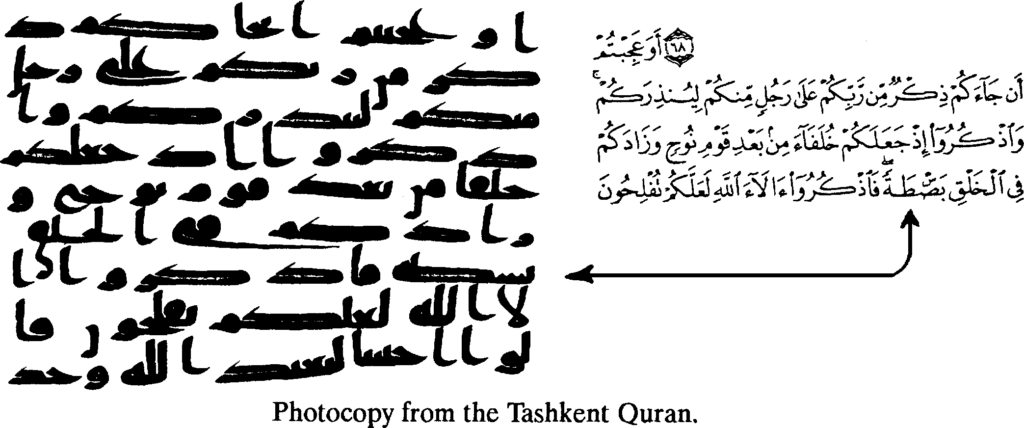
The final piece of evidence is that the oldest written copies of the Quran that contain verse 7:69 (such as the Tashkent Quran) write “bastatan” with a letter “seen”.
The Initial “Noon”
The Quranic initial “Noon” is found in Surah 68 only.
According to Rashad Khalifa, this Quranic initial is the only one where the Arabic letter is spelled out with other Arabic letters, rather than written alone.
- It is like if someone spelled out the letter D with the letters “d e e” rather than simply writing the letter D. It is the case that this Quranic initial “Noon” is spelled out with the letters “Noon waw noon”.
People have accused Rashad of trying to distort the Quran with his claim, but his messengership confirms that this is the correct way to spell this Quranic initial in Surah 68. Verse 98:2 is saying that the messenger recited purified pages of Quranic text, and this was one of the verses that Rashad was informed about which referred to him.
- The Quran’s 19-based structure also confirms that Rashad’s spelling is the correct one.
One indication that the Quranic initial “Noon” is spelled out as “Noon waw noon” is in verse 21:87. Here, God refers to the prophet Jonah as “Dhan-Noon” (which means possessor of the letter Noon). That’s because the Arabic version of the name Jonah (Yunus) has the letter “Noon” in the name. The letter “Noon” in this title given to Jonah is spelled out as “Noon waw noon” rather than a standalone letter Noon.
- Islamic scholars believe that this title for Jonah (Dhan-Noon) means “person of the fish/whale” as a guess for what this mysterious term could mean. But in reality, the spelling “nun waw noon” does not spell any known Arabic word, and is most certainly not the Quranic term for fish. The Quran actually refers to Jonah in Surah 68 as “sahib il-hoot (Companion of the Fish)”. The term “hoot” means fish in the Quran, not “Noon”.
- So, we can be quite confident that “Dhan-Noon” means one who possesses letter “Noon”, referring to the prophet Jonah who has the letter Noon in his name. Therefore, verified precedent exists in the Qur’an to spell out the letter noon in verse 68:1 as “Noon waw noon”.
Additionally, Harvard University launched a website known as “Encyclopedia of the Variant Readings of the Qur’an” also known as EVQ. The EVQ documents the many different transmissions of the Quranic verses, as well as who transmitted them.
Here is a data table about verse 68:1 derived from the information in the EVQ:
| Ch:Vrs | Arabic | Transmission | Manual | Page | Footnotes |
|---|---|---|---|---|---|
| 68 : 1 | نُونِ | al-Aʿmash | Mukhtaṣar | 124 | |
| 68 : 1 | نُونِ | Ibn ʿAbbās | Mukhtaṣar | 159 | |
| 68 : 1 | نُونِ | Abū al-Sammāl | Mukhtaṣar | 124, 159 | |
| 68 : 1 | نُونِ | Ibn Abī Isḥāq | Mukhtaṣar | 159 | |
| 68 : 1 | نُونِ | al-Ḥasan al-Baṣrī | Itḥāf | 2:553 | |
| 68 : 1 | نُونَ | ʿĪsā b. ʿUmar al-Thaqafī | Mukhtaṣar | 124 | |
| 68 : 1 | نُونَ | Saʿīd b. Jubayr | Mukhtaṣar | 159 | |
| 68 : 1 | ن وَّالْقَلَمِ | Ibn Muḥayṣin | Mufrada IM | 145 | Reading |
| 68 : 1 | ن وَّالْقَلَمِ | al-Shāfiʿī | Kāmil | 345 | Reading |
| 68 : 1 | ن وَّالْقَلَمِ | al-Aʿmash → al-Shanabūdhī | Itḥāf | 2:553 | |
| 68 : 1 | ن وَّالْقَلَمِ | Ibn ʿĀmir | Shāṭibiyya | ||
| 68 : 1 | ن وَّالْقَلَمِ | ʿĀṣim → Shuʿba | Shāṭibiyya | ||
| 68 : 1 | ن وَّالْقَلَمِ | al-Kisāʾī | Shāṭibiyya | ||
| 68 : 1 | ن وَّالْقَلَمِ | Yaʿqūb | Durra | ||
| 68 : 1 | ن وَّالْقَلَمِ | Khalaf | Durra | ||
| 68 : 1 | ن وَّالْقَلَمِ | Nāfiʿ → Warsh | Shāṭibiyya | Reading | |
| 68 : 1 | ن وَالْقَلَمِ | Nāfiʿ → Warsh | Shāṭibiyya | Reading |
We can see that one Sahabah, or companion (ibn Abbas), two of the tabi’een (Sa’id ibn Jubayr, al-Hasan al-Basri) and four of the atba’ at-tabi’een (Isa ibn Umar al-Thaqafi, Ibn Abi Ishaq, al-A‘mash, Abu al-Sammal) believed that the spelling of verse 68:1 as “Noon waw Noon” was valid.
The Arabic grammar and Quranic tafsir scholar al-Khalawayh (who lived from 890 CE to 980 CE) wrote a book called Treatise on Variant Readings of the Qur’an (Kitab al-Badi’).
- In that book, he listed ibn Abbas, Ibn Abi Ishaq, Abu al-Sammal, and Sa’id ibn Jubayr as people who stated that the Quranic initial in verse 68:1 was spelled as “Noon waw Noon”.
Lastly, a Quran manuscript written in Baghdad in the year 1000-1001 CE by ibn al-Bawwab has two letters Noon in the Quranic initial of verse 68:1, instead of a single letter Noon. The second “Noon” is visible in red ink.

Rashad’s Message
So, what is the message that the Messenger of the Covenant was sent with?
1. Confirming the Quran With Number 19
His first and primary mission given by God was to confirm the Quran and all previous scriptures of God as the truth from God, as stated in verse 3:81.
But how is he supposed to confirm the Quran and all previous scriptures? The Quran clarifies in verse 74:30-31 that the number 19 will cause Jews, Christians, and Muslims to increase their faith and their certainty, and remove the doubts from their hearts.
Such increase in faith and certainty, and the removal of doubt, can only happen if the number 19 confirmed and proved that the Quran is the truth from God.
- If the number 19 confirmed the Quran, then the number 19 also confirmed all other scriptures which came before the Quran (Gospel, Torah, the scriptures given to Abraham and David, and others).
Thus, Rashad’s main duty, as given by God in the Quran, is to confirm the Quran as the truth from God by using the number 19.
- The way Rashad fulfilled this duty is by teaching the Quran’s 19-based mathematical system.
2. Confirm That the Quran Alone Is the Straight Path
Another duty given to Rashad in the Quran in verse 3:81 to practice and preach following the Quran alone. Verse 3:81 says that the messenger of the covenant will come after all the prophets are given their scriptures, which means this messenger will be sent under the law of the scripture given to the final prophet (Muhammad).
- The law of Muhammad is the Quran alone. Hence, according to verse 3:81, God will send the Messenger of the Covenant to follow, teach, and invite to the Quran alone.
This was fulfilled in 1980, sometime after his 45th birthday, Rashad was approached by the angel Gabriel, who told him, “You are one of the messengers. Surah Ya Seen, 3, applies to you.“
Now, if anybody is familiar with Surah Ya Seen, they would know that verse 4 is a continuation of verse 3. The two verses, when combined, says:
- [36:3-4] Indeed, you are one of the messengers, on a straight path.
In short, God told Rashad through Gabriel that he is a messenger who is on the straight path.
- That means the path that Rashad was following at the time (following the Quran alone, and rejecting Hadith as a source of Islamic law) is the straight path.
3. Convey the Time of the End of the World
Another of Rashad’s responsibilities as messenger that was mentioned in the Quran is to convey the time that the world will end. To keep it very brief, the Quran said in verse 20:15 that God “almost hides” the Hour.
- The “Hour” is an event, and all events consist of three things: time, place, and action. We all know the action (destruction of the universe) and the place (the universe). But the only unknown part of the Hour is the time.
- So according to verse 20:15, the timing of the Hour is not fully hidden, but is almost hidden.
- Think of it like this: let’s say that someone has a hemoglobin A1c level of 5.6%, and the threshold for prediabetes is an A1c level of 5.7%. Does that person have prediabetes or not? The answer is no, he is not a prediabetic, but he is almost a prediabetic.
- Likewise, if the timing of the Hour is not hidden, but it is almost hidden. If it is not hidden, then this information is available somewhere.
- Now why did God not hide the time of the Hour? That is because God wants people to know the time someday. If God never wanted the people to know the time in advance, He would have hidden this information fully, rather than keep it almost hidden.
- It’s like when someone buries some treasure, then leaves behind clues (such as a treasure map) and hints about the location of the treasure; the location of the treasure is not quite hidden, but it is almost hidden. The only reason the owner of the treasure wants to keep it almost hidden and leave behind clues is so that someone in the future finds it.
- Alright, but where did God put the timing of the end of the world, if it is not hidden? The timing of the end of the world must be somewhere inside the Quran, because verse 43:61 says, “And indeed, it (the Qur’an) is definitely a source of knowledge for the Hour. So do not doubt it, and follow Me. This is a straight path.” So everything we need to know about the Hour (including its time) is inside the Quran.
- The Hour is “unseen” (ghayb) information, and verse 72:26-27 says that God only makes known unseen information to a messenger whom He chooses. So a messenger of God must be the first one who finds out this information from inside the Quran and shares this knowledge to the public.
- Prophet Muhammad was not permitted to know the timing of the Hour (verse 7:187). So a messenger after prophet Muhammad was destined to find out the timing of the Hour from inside the Quran. Rashad is the only messenger mentioned in the Quran after prophet Muhammad (verse 3:81), so he must be the one chosen to complete the task of discovering from the Qur’an the timing of the end of the world.
- Rashad found out in the year 1980 from the Quran that the world will end in the year 2280 CE. I provide an in-depth explanation from multiple Quranic verses about why this is the correct time for the end of the world in this link.
Some might say, “But doesn’t the Quran tell the prophet to say the knowledge of the Hour is only with God?”
Yes, but just because the knowledge of something is only with God, does not mean the knowledge will stay only with God forever. The Quran, for example, used to be unseen (ghayb) information. The Quran was only known to God before prophet Muhammad was the messenger chosen to convey it to the public.
For any unseen information (such as the time the world will end), the knowledge is with God alone, unless He chooses to make this information known to the people. If God decides to make known any part of the unseen, He will only do so through a chosen messenger. This messenger will be the first person to know this information, before spreading it to the public.
- [72:26-27] The Knower of the Unseen, but He does not make His unseen known to anyone, except a messenger of whom He has approved…
Some might respond: “Doesn’t the Quran say the Hour will come suddenly? How can we know the time in advance if it comes suddenly?“
The answer is yes, the Hour will come suddenly…for the disbelievers. Not once does the Quran say that the Hour will come suddenly for the believers. That is because the believers will know exactly when it will occur.
These are all the verses where the word “baghtah” (suddenly) appears in connection with the Hour, indicating the Hour will not come suddenly for believers, but it will come suddenly for the disbelievers and the wrongdoers:
- [43:65-66] But the parties differed amongst themselves, so woe to the ones who committed wrongdoing, from the punishment of a painful Day. Do they (wrongdoers) wait but for the Hour, that it should come to them suddenly, while they do not realize?
- [47:18] So do they (disbelievers) wait but for the Hour to come to them suddenly? But certainly, its preconditions have come. So what good will their reminder be for them (disbelievers) when it has already come to them?
- [29:55] But the ones who disbelieved will not cease to be in doubt of it until the Hour comes to them suddenly, or the punishment of a barren Day comes to them.
- [6:37] Certainly, the ones who denied the meeting of God have lost. Until when the Hour came to them suddenly, they said, “Oh, our regret over what we have neglected concerning it!”…
- [7:187] They (disbelievers) question you (Muhammad) of the Hour, “When is its arrival?” Say, “Its knowledge is only with my Lord. None will reveal its time except Him. It weighs heavily in the heavens and the earth. It will not come to you (disbelievers) except suddenly.” They (disbelievers) ask you as if you are knowledgeable about it…
Some might ask, “Why does the timing of the end of the world matter? Why should I care?”
- Personally, it does not matter to me much when God wants to end the world. It’s His creation, so He alone has the right to choose the end date.
My concern is that people continue to attack and criticize Rashad as a false messenger because he said the world will end in 2280 CE. So it’s important to set the record straight:
- The Quran says the timing is “almost” hidden (verse 20:15). If something is almost hidden, that means it is not actually hidden. Therefore, this information is available somewhere and can be found. God did not hide this information from the public because He wants it to be known someday.
- The knowledge of the Hour is only with God, and Muhammad does not have access to it (verse 7:187), but it is in the Quran somewhere (verse 43:61).
- God will only make the unseen known through a messenger (72:26-27). Since the time of the Hour is unseen information, but God will make it known someday, and Muhammad was not permitted to know it, this logically means God will make it known through a messenger after Muhammad.
- The messenger coming after Muhammad that is directly mentioned in the Quran is the Messenger of the Covenant (verse 3:81), and Rashad Khalifa is that messenger. That means according to the Quran, God wrote the time of the Hour in the Quran somewhere, and God will make Rashad be the first to find it from the Quran and convey it to the world.
4. Other Revelations
Additionally, Rashad himself said that all information he receives and passes on to the people from God is already found in the Quran (Muslim Perspective, February 1990). Here are some additional messages that God communicated to Rashad through the angel Gabriel.
- The explanation of verse 3:81 that Rashad received in 1988 after he was restored to his position as messenger, that not only was he a messenger, but he is the Messenger of the Covenant mentioned in this verse. God explained to Rashad that his meeting with the prophets in Heaven many years before was the fulfillment of the covenant in verse 3:81.
- The proclamation that all who die before age 40 will go to Heaven (the Quranic evidence of this, verse 46:15, is discussed here). Rashad said in Appendix 32 and in a Quranic study session that he was tasked by God to deliver this piece of information.
- The message that after Rashad dies, millions of believers will know that he is the Messenger of the Covenant, who represents the Messiah the Jews are waiting for, the second coming of Christ that the Christians anticipate, and the Mahdi that Muslims anticipate. This does not mean he is all three of these people. Rather, it means he is neither the Mahdi, nor the Christ, nor the Messiah, but was sent by God in their place. This is evident from the complete and fully detailed Quran, which does not mention the second coming of Jesus or a future Messiah, but mentions the coming of Rashad in verse 3:81.
- Rashad received a message from God, who stated that like the time of Noah, those who refuse to stand with God’s Messenger of the Covenant will be destroyed.
- A “new proclamation” from God that Rashad received, instructing people of all religions to “Purify, unify, and consolidate your religions into one,” by forgetting all idols and devoting themselves totally to God alone. This will be the bare minimum needed to attain salvation. This message is discussed in depth here.
- Shortly before his mother’s death, Rashad was informed that the righteous people do not taste death after their life on Earth ends, but they are alive and conscious in Paradise.
5. Quranic Verses Referring to Rashad
Let’s say that someone asks, “What Quranic verses are directly addressing Rashad, or talking about Rashad Khalifa, apart from verse 3:81?”
- The Quran is valid for all times. Therefore, any verse that is traditionally believed to be talking to or about Muhammad, but is general enough to be talking to or about Rashad due to him being a messenger too, can and should be interpreted as such.
From time to time, God used a small subset of verses (out of all verses that are applicable to Rashad) to communicate with Rashad, by saying something like, “Verse so-and-so refers to you,” and “This verse refers to you.”
You have already learned about verse 36:3. The very first message that was sent to Rashad through Gabriel was that he was one of the messengers and that verse 36:3 referred to him.
- Besides that, the other verses that Rashad said that God said they refer to him are: Verses 98:2, 81:19-24, 72:1-28, 61:9, 48:28, 46:35, 44:13, 43:43, 42:24, 41:43, 35:24, 34:28, 34:43, 34:46, 28:44, 26:214-223, 25:27-30, 25:56, 24:62, 22:49, 13:37-38, 13:30, 9:33, 5:19, 3:81, 2:252, 2:119, and 2:23-24.
- Those are not the ONLY verses that are addressing Rashad of course. Verse 38:65, is not one of the listed verses, but it tells the messenger to say, “I am only a warner.” Since Muhammad is a messenger and a warner, this verse applies to him. But since Rashad is also a messenger and a warner, this verse applies to Rashad too.
- But the listed verses just the ones that Rashad said God specifically pointed out to him. This is just how God used verses of the Quran itself to communicate to Rashad.
During a Quranic study, when discussing Surah 72 and what Rashad learned from God, he stated that God inspired to him that a group of formerly Christian jinns walked by his masjid (Masjid Tucson) and heard the Quran there. After learning about how amazing the Quran is and its miracle, they became believers.
Here is what Rashad said, when discussing Surah 72 during a Quranic study session, after discussing how the Surah is addressed to Rashad himself:
- “This is not my personal opinion. If this was my personal opinion, I’d be wrong. This is not my personal opinion.”
- “And when I tell you this, either I’m a very, very bad person, or I’m really a messenger of God. Because nobody will fabricate lies against God and attribute it to God in this flagrant manner, unless he’s really, really a disbeliever who doesn’t think he will face God one day on the Day of Judgement. So take your pick, there are only two extremes here: either a very bad person who claims to be receiving information from God, or a true messenger of God.”
Anything else beyond this is Rashad’s own statement and opinion, not revelation from God. Because he is human and not perfect, any statement that Rashad made beyond revelation must be verified by comparing it with what the Quran says.
Conclusion: The Killing of Rashad
The Islamic Fiqh Council is the organization of the Muslim World League that specializes in Islamic law.
The Islamic Fiqh Council held their 11th conference in Mecca on February 1989. The chairman of that conference was Abdul-Aziz ibn Baz, who would become Saudi Arabia’s Grand Mufti 4 years later. The organization issued a fatwa (religious ruling) labelling Rashad Khalifa as “apostate” and “criminal”. And Rashad was also falsely accused in this fatwa of claiming to be a prophet (which Rashad has strongly denied, multiple times).
- You can view the entire fatwa by clicking this link.
In Sunni Islam, apostasy (a Muslim becoming a non-Muslim) is punishable by death because it is one of the three valid reasons to take the life of a Muslim. Thus, by falsely labelling Rashad an apostate, the IFC may have inspired Sunni terrorists to take action and murder Rashad.
- Abdullah ibn Masud reported Allah’s Messenger as saying, “It is not permissible to take the life of a Muslim who bears testimony to the fact that there is no god but Allah, and I am the Messenger of Allah, but in one of the three cases: the married adulterer, a life for a life, and those who leave his religion (Islam), abandoning the community.” (Sahih Muslim, No. 1676)
The Muslim World League and the IFC used to be just a propaganda organization for spreading Wahhabi Islam before becoming moderate. Wahhabis strongly believe in the death penalty for apostasy. In fact, apostasy is punishable by execution in Saudi Arabia because of Wahhabi influence.
- So when the Wahhabi scholars who wrote this fatwa declared Rashad as an apostate, this meant that they wanted him dead. Very likely, the Saudi Arabian authorities would have arrested Rashad and executed him if he had went there for Hajj in 1989.
Since this fatwa, the death threats against Rashad intensified, both verbal and written. Investigators in 1989 (after the IFC’s fatwa) uncovered a four-page murder plan found in a storage locker to assassinate Rashad Khalifa, written by members of the terrorist group Jamaat ul-Fuqra.
The plan was to stab Rashad to death inside the masjid kitchen at night, and it said that the knife was chosen because it was the quietest possible murder method. Shooting Rashad was discussed as an alternative. There were also pictures of surveillance footage of the inside and outside of the masjid found in the locker along with the murder plan.
Rashad Khalifa was ultimately beaten and stabbed to death 29 times inside Masjid Tucson’s kitchen before sunrise on January 31st, 1990, by a Jamaat ul-Fuqra affiliate.
The assassination was done in a manner that is consistent with the written plan. The murder was “a carbon copy of the handwritten plan,” according to Colorado’s former assistant attorney general Doug Wamsley.
The image below shows Glen Francis, the Jamaat ul-Fuqra affiliate who assassinated Rashad Khalifa in 1990, and was subsequently arrested in 2009 after evading the police for 19 years:

Several other members of Jamaat ul-Fuqra, such as James Williams (who was the leader of al-Fuqra’s local branch in Denver, Colorado) were arrested for being involved in the 1989 conspiracy to murder Rashad.
So while justice has been served, the most important thing that all Muslims should do now is to accept Rashad as messenger and follow the message he was sent with: the Quran alone.
Additional Resources
Rashad Khalifa’s newsletters and his translation of the Quran (plus Appendices) can be found on the website of the masjid he founded:
This is a YouTube playlist of Rashad’s recorded group Quranic study sessions: (56) 01 Quran Study From Azhar 1 Sura 72;19 28 & Sura 73 By Kathryn Jinns 05 26 1989 – YouTube
And here is a recommended YouTube playlist of various recorded speeches and Friday sermons from Rashad Khalifa: 01 What Life is All About & Who is GOD?
Leave a Reply