
Salaamun alaykum, dear readers!
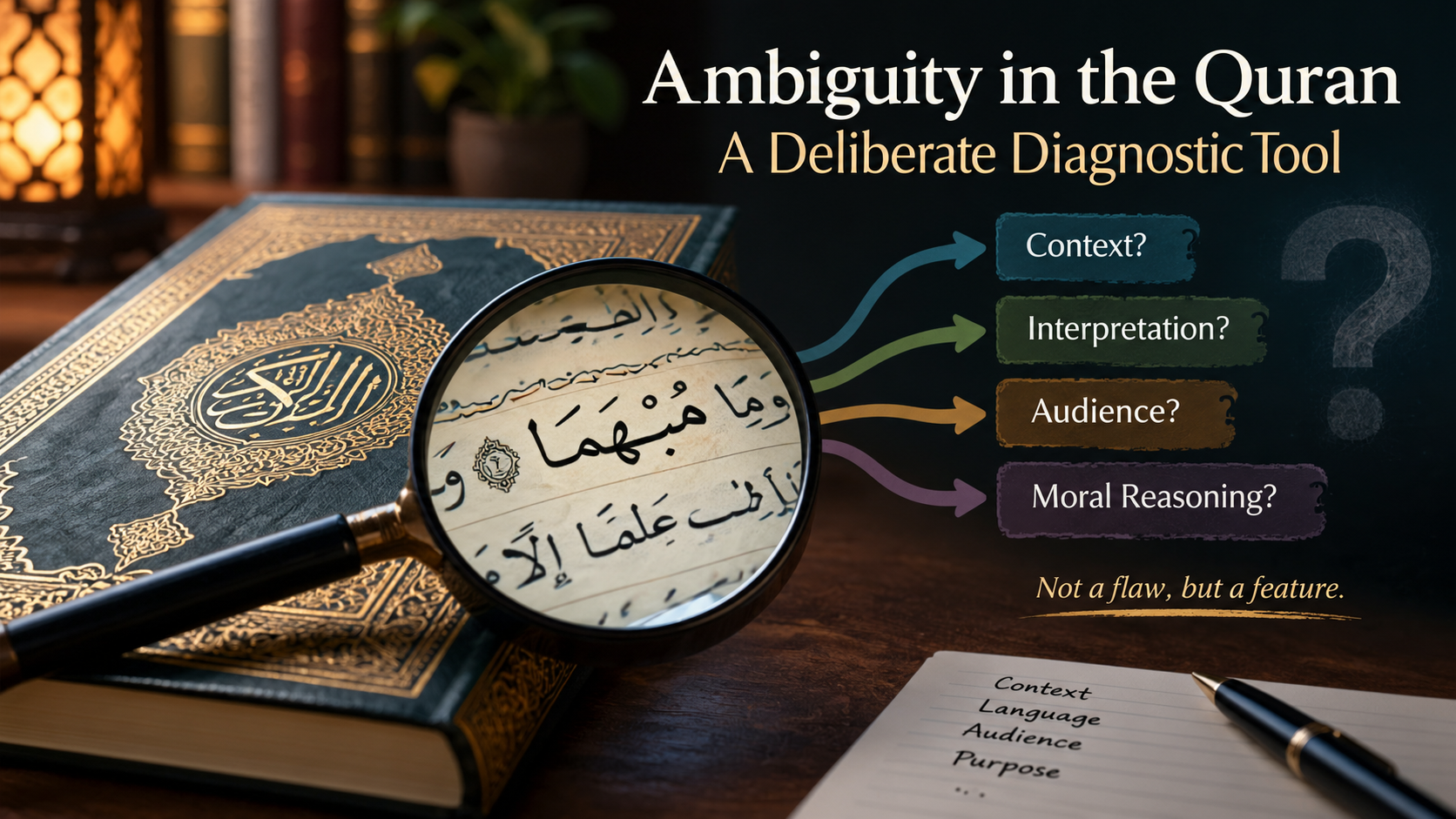
When reading the Quran, we notice a recurring pattern: it frequently uses verses that are multi-meaning, or appear to have multiple meanings, to intentionally misguide people who want to abuse the Quran in support of opinions that actually violate or contradict the Quran. God in the Quran says that this was intentionally done to allow such people to do it.
- [3:7] He is the One who brought down upon you the Book containing clear verses that constitute the foundation of the Book, and others that allow multiple meanings. As for those who harbour deviation in their hearts, they pursue the multiple-meaning verses, seeking to cause discord and seeking to interpret it, but none know its true interpretation except God. And those well-founded in knowledge say, “We believe in it; all of it is from our Lord.” But none will take heed except those who possess intelligence.
- [17:82] We bring down of the Quran that which is a healing and mercy for the believers, yet it (Quran) does not increase the transgressors except in loss.
Additionally, the Quran says God wants us to take the time to study it. So, the Quran uses multiple-meaning words to allow people to find the correct meaning when studying other verses of the Quran
- [6:105] We thus diversify the verses, so that they would say, “You have studied,” and to clarify it for a people who know.
- [9:122] It is not for all the believers to march forth. A group from every division should remain behind to attain the understanding of the religion, and to warn their people when they return to them so that they may beware.
- [47:24] Do they not reflect on the Quran? Or do the hearts have their locks on them?
In other words, ambiguity is deliberately utilized by God in the Quran as a diagnostic tool to encourage studying and reflecting on the whole Quran to find answers instead of simply taking a quick glance at a handful of verses, and to help determine where someone’s heart is oriented towards.
Slavery
Let’s start with slavery for example. A few verses in the Quran mention that a person can have lawful intercourse with their slaves, but these verses do not directly mention that mutual consent of the slaves is needed before sexually accessing their bodies.
- [23:5-6] And those who guard their genitals, except from their spouses, or what their right hands possess, with whom they are free from blame.
So this verse has a possible double-meaning which indicates that consent is not necessary for sexual access to a slave’s body, because it states that slaves are “what your right hands own/possess”. It is believed that because a person is owned, that person’s consent is unnecessary.
Rather, the Quran strongly implies elsewhere that you must not rape your slaves by saying that slaves are entitled to the same respect and good treatment as free people (verse 4:36). Moreover, the Quran encourages people to show compassion for all matters, wherever it is possible, without injustice (verse 90:17). Needless to say, intimacy with slaves without their consent (which is rape) is not compassionate at all and is the opposite of the treatment mandated in verse 4:36.
- [90:11-17] But he has not attempted to break through the difficult path. And how would you know what the difficult path is? It is the freeing of a slave, or feeding on a day of great hunger an orphaned relative, or a needy person in misery, and then to be one of those who believed and encouraged one another to exercise patience, and encouraged one another to show compassion.
- [4:36] Worship God and do not associate anything with Him, and be good to the parents, the relatives, the orphans, the needy, the close-by neighbour, the distant neighbour, the close friend, the homeless and those whom your right hands possess. Indeed, God does not like the ones who are arrogant and boastful.
Yet the mainstream Sunni opinion is that it is obligatory (wajib) for an unmarried female slave to submit to her master for sexual intimacy if he requested it, even if she did not want to do it.
- In other words, Sunni-ism legalized the raping of slaves against the orders of the Quran, which was likely one of the incentives for why the horrible Arab slave trade has continued on for 14 centuries after the Quran’s revelation.
Did Jesus Die?
The Quran says that yes, Jesus died when the disbelievers attempted to crucify him.
- [3:54-55] They schemed, but God schemed, and God is the Best of Schemers. God said, “O Jesus, I am taking you back (mutawaffeeka), raising you to Me and purifying you of those who disbelieved. I will place those who followed you above those who disbelieved until the Day of Resurrection. Then to Me is your return, and I will judge between you regarding that over which you used to differ.
The term “mutawaffeeka” and “yutawaffa” is never used to mean “taking” as in, “I am taking a bottle of water off the shelf,” in the Quran. When you physically take something, the correct Arabic term for that is “yattakhadha” or “muttakhidha”.
Rather, in all cases in the Quran, this word “yutawaffa” and its related words means that a person’s soul is being taken when their life on Earth is ending.
- [39:42] God takes back (yutawaffa) the selves at the time of their death and also of those who have not died during their sleep. Then He retains those for whom He has decreed death and sends the others back for a specified term. Indeed, in that are signs for people who reflect.
A verse in the Quran says that the crucifiers believed they killed Jesus, but in reality they did not crucify him or kill him.
- [4:157-158] And their saying, “We have killed the Messiah, Jesus, son of Mary, the messenger of God.” In fact, they did not kill him, nor did they crucify him, but it appeared to them that they did. Those who differ over it are in doubt about it. They have no knowledge of it; they only follow conjecture. For certain, they did not kill him. Rather, God raised him unto Him. God is Dignified, Wise.
So there are two possible meanings of this verse:
- The first meaning is: Jesus is still alive in his body like how we are alive, since the year 33 CE, and the body that Jesus’s captors believed they crucified was just a fake body or lifelike mannequin.
- The second meaning is: Jesus’s life was terminated on the day of his crucifixion, and his soul was taken from his body. However, the reason he died was not because of the crucifixion, but because God already took the soul immediately before Jesus can experience fnce any suffering from the crucifixion, so they just crucified Jesus’ real, but empty, body.
The predominant Sunni interpretation is the first meaning. However, this is incorrect because verse 3:55 already stated in advance that Jesus’ soul was taken and raised up to God before he was crucified.
Likely, in this case, God used a double-meaning verse to test whether people would examine the full Quran before interpreting this verse, or ignore parts of the Quran in favor of an interpretation that is derived from sources outside the Quran.
The Jizyah
Verse 9:29 was abused by Muslim conquerers to commit actions that are egregiously in violation of the Quran. Such abusers of verse 9:29 unfortunately included Caliphs Abu Bakr and Umar, who were two of prophet Muhammad’s fathers-in-law, and Caliph Uthman and Ali, who was the prophet’s son-in-law and cousin respectively.
I am not criticizing the sincerity of the faith of the four Rashidun Caliphs, nor do I think that they intentionally abused any verse of the Quran. They were 7th century Arabs, and they understood the Quran with the mindest of 7th century Arabs.
But the harsh truth is that they invaded and conquered the territory of sovereign people (namely, the Byzantine and Persian Empire) who did not attack or commit any act of aggression against the Muslims. That is a direct violation of the Quran. And God in the Quran gave Muslims the duty to honestly condemn bad deeds like this, even if they were committed by the people whom we look up to as heroes.
Verse 9:29 states to fight the Jews and Christians until they give the jizyah (a derivative of the Arabic word “jazaa” which means penalty and recompense).
- [9:29] Fight the ones from among those who were given the Scripture who do not believe in God, nor in the Last Day, nor prohibit what God and His messenger have prohibited, nor abide by the religion of truth, until they give the jizyah (penalty money) from hand, and they are humbled.
So this verse has two possible meanings:
- Meaning 1: Muslims must wage war against all non-Muslim territories until the non-Muslims give the Muslim conquerors a jizyah (penalty money), then after the payment of the jizyah, they get to live freely while Muslims govern the territory. The “jizyah” (penalty money) is interpreted in this case to be a tax that is paid periodically by non-Muslims in Muslim lands, even during peacetime.
- Meaning 2: The fighting mentioned in verse 9:29 is only for self-defense against Jews and Christians who started the fight, and the jizyah (penalty money) is the reparations that the Jews or Christians pay if they lose the war. The jizyah is not interpreted as an ongoing peacetime tax, but it is a fixed reparations payment made after a war as a consequence of starting that war.
Meaning 2 is the one that is supported in the Quran, because trespassing on other people’s property (including foreign lands) is explicitly prohibited elsewhere in the Quran, and because the Quran elsewhere only permits defensive warfare and prohibits fighting and aggression against who do not fight you.
- [4:90] Except for those who join people with whom you have a treaty or those who come to you with hearts reluctant to fight you or to fight their own people. Had God willed, He could have charged them against you, and then they would have fought you. Therefore, if they leave you alone, refrain from fighting you, and offer you peace, then God gives you no claim against them.
- [4:91] You will find others who wish to be safe from you and safe from their own people. Every time they are returned to the test, they plunge into it, causing their condemnation. So if they do not leave you alone, nor offer you peace, nor withdraw their hands, take them and kill them where you encounter them. Over these, We have given you clear authority.
- [8:61] If they should incline to peace, so shall you be inclined, and put your trust in God. Indeed, He is the Hearer, the Knowledgeable.
- [2:190] And fight in the cause of God those who fight you, but do not aggress. Indeed, God does not like the aggressors.
- [24:27-28] O you who believe, do not enter homes other than your homes until you have been made welcome, and until you greet their people. This is better for you, may you then take heed. If you find no one in them, still do not enter them until you are given permission. If you are told, “Go back,” then go back. This is purer for you. God is Knowledgeable of what you do.
- Obviously, invading and conquering foreign lands against their will when they did not even attack you in the first place (like what the Caliphs of the Islamic Empire did to grow the size of the empire) is an aggressive act of war, hence is Quanically prohibited.
The wisdom of having verse 9:29 contain a double-meaning is likely to test the early Muslims to see who will let their desire for expansion and empire-building cause them to choose the interpretation that is disobedient to the Quran, over the interpretation that is consistent with the Quran.
It is also a great test to see who will prioitize what the majority of Muslims say over what God in the Quran says, even if the majority opinion is not just wrong, but egregiously wrong.
Application of Islamic Law
Muslims are told by God in the Quran that compulsion in the religion is completely prohibited. That means no person should force another person regarding anything involving Islam.
- [2:256] There shall be no compulsion in the religion. Correctness has been distinguished from error…
We are also told not to disobey God.
- [4:14] And he who disobeys God and His messenger and oversteps His limits, He will admit him into a Fire wherein he shall permanently remain, and for him is a humiliating punishment.
As a result, any punishment that is mentioned in the Quran has multiple meanings, such as the 100 lashes that was prescribed as the punishment for unlawful sex.
- [24:2] The adulteress and the adulterer: lash each of them a hundred lashes. Do not let compassion for them overcome you with regards to applying God’s religion if you believe in God and the Last Day, and let a group of believers witness their punishment.
So there are two possible interpretations of verse 24:2:
- Meaning 1: 100 lashes to any proven adulterer or adultress, even against his or her will.
- Meaning 2: Don’t lash a proven adulterer or adultress without his or her consent, to avoid violating the non-compulsion rule in verse 2:256.
So which meaning is correct? Let’s put the puzzle pieces together. What is the only way to obey the command of verse 24:2 (100 lashes for the adulterers and fornicators) without violating any other verse of the Quran? Logically, the way to do that is by only giving the 100 lashes if the guilty have willingly consented to receiving the punishment.
Therefore, Meaning 2 is actually the correct interpretation, even though most Muslims agree with Meaning 1.
Another significant problem with Meaning 1 is that the Quran does not discriminate between Muslim or non-Muslim; the punishment applies to all. So that means a non-Muslim who sees nothing wrong with sex before marriage will be punished against his will for breaking the rules of a religion that they do not even believe in. That is the same kind of injustice as a Muslim being punished by Christians for having a no-fault divorce (no-fault divorce is not allowed in Christianity, but is allowed in Islam).
The same applies to any other part of Islamic law. All Quranically-prescribed punishments must be carried out only if the guilty consent to the punishment. That includes capital punishment and cutting the hand of the thief.
- That does not mean there cannot be any kind of punishment for any crime. The Quran mandates people to stand up and defend themselves when afflicted by injustice (verse 42:39), and having having legal punishments against crimes is a kind of collective self-defense against the criminals of society.
- But only the Quranically-prescribed punishments require the consent of the guilty before being carried out against them, to avoid violating the prohibition against compulsion in the religion.
Conclusion
The Quran was intentionally made to be studied. Ambiguity is deliberatey utilized in the Quran diagnostic tool that helps us learn more about our mindset. It helps us learn whether or not we truly respect God and want to study the Quran, or whether we just want to blindly follow what the majority of people says and does.
- [6:105] We thus diversify the revelations so that they would say, “You have studied,” and to clarify it for a people who know.
- [47:24] Do they not reflect on the Quran? Or do the hearts have their locks on them?
A Muslim who truly respects God will never knowingly accept any interpretation of any multiple-meaning verses of the Quran that permits evil and injustice, or or any interpretation which violates other verses of the Quran. Especially if the violation is as horrendous and abhorrent as the idea that raping your own slaves by forcing them to have sexual relations with you without their consent is halal (permissible).
So if you are a Muslim, you have to ask yourself: Do you respect God, or not?
Leave a Reply