
Saalamun alaykum, dear readers!
When we examine the full history of how life on Earth came to exist, we find that Earth is the recipient of so many “coincidences” that allowed it to become habitable. Coincidences, in this case, refer to chance events that do not ordinarily happen to the vast majority of planets.
Without even one of those coincidences, life would likely not have developed on Earth at all. So while we often tend to take our existence for granted, the big picture is that planet Earth is able to host life because of extreme luck.
Of course, if you believe and worship God, you would know that nothing is truly a coincidence. It would not come as much of a shock or surprise to you. But taking a deep dive into just how lucky we truly are gives both atheists and believers a lot to be thankful and appreciative for.
Earth’s Collision with Planet Theia

Early in Earth’s history, the planet was just a big sphere of lava. It lacked a stable surface Thus, it was a protoplanet at the time because it was still being fully formed.
What happened to Earth was that it cooled down enough to form a thin, fragile crust. But then, suddenly, a Mars-sized protoplanet named Theia collided with Earth.
That collision completely destroyed Theia, causing most of its remnants to be absorbed into Earth. Our planet survived the impact, but Earth’s crust and mantle became re-melted and partially vaporized due to the impact.
The vaporized portion of Earth and Theia after the collision eventually cooled down and came together to form our Moon.
This collision had such an outsized impact on Earth and its ability to host life and have nice weather, and here is why:
1. The Effect of Earth’s Moon

When compared to all 8 planets, Earth’s Moon is the biggest moon in the solar system compared to its host planet. As a result, Earth’s moon has a larger gravitational impact on its planet than the other moons have on their planet.
Because of the moon’s gravitational pull, Earth’s rotation has very minimal wobble, therefore its rotation is very stable. Think of a spinning top, for example. As the spinning top slows down, it becomes very wobbly.
Thus, without Earth’s large moon, Earth’s rotation would have been too wobbly and chaotic, and that would have caused the weather to be too extreme for complex life to form and thrive here. So our moon isn’t just there for our nighttime viewing pleasure, it has a lifesaving role in stabilizing Earth’s orbit and giving us the stable climate that we need for survival.
Additionally, the role of moon’s gravity is the tidal waves that it causes on Earth’s oceans. Tidal waves are important for life and weather because they help distribute nutrients and heat across the entire ocean. In fact, scientists believe that tidal activity helped jumpstart the chemistry needed for life on Earth to form, and contributed to the evolution of the first terrestrial (land-dwelling) lifeforms.
2. Earth’s Axial Tilt
It is common knowledge that Earth has seasons because it is tilted on its axis by an angle of 23.5 degrees.
- If Earth was not tilted on its axis, there would be no seasons. Instead. the middle of the Earth would be overheated, and the regions near the top of Earth would be far too cold.
- Moreover, if Earth’s angle of tilt was slightly higher than it currently is, then its summers and winters would be far more extreme than they are today.
It turns out that Earth only became tilted because of its collision with the planet Theia, and the tilt was at a good angle that allowed Earth to avoid hyperextreme seasons.
3. Earth’s Magnetic Field
When Theia collided with Earth, its iron-rich core collided with Earth’s core. Both cores merged to form Earth’s current large, iron-rich core that we have today.
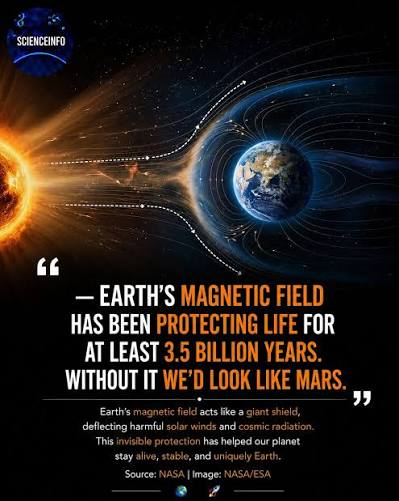
Iron is a very magnetic element, and the movement of the liquid iron in Earth’s core is what generates the electrical currents that create Earth’s magnetic field.
We need the magnetic field because it deflects the harmful solar winds that come from the sun. Without the magnetic field, the solar winds would blast away Earth’s atmosphere and bombard Earth’s surface with deadly radiation.
While Earth’s core already had some iron before the collision, Theia added significantly more iron to the core. A larger core meant more internal heat from the core, and heat was crucial to creating the movement of the liquid iron in the core needed to form the magnetic field.
If Theia did not collide with Earth, many scientists believe that our planet’s magnetic field would have been significantly weaker because Earth’s core would have had too little iron and heat. Thus, over time, our atmosphere would have gradually been stripped away.
Additionally, our Moon’s gravity helps stir the liquid iron in our core as well, which further contributs to the strength of Earth’s magnetic field. As we already know, the moon is a result of the Theia collision.
Earth’s Chemistry
Earth has a narrow “chemical Goldilocks zone” involving oxygen.
If there was not enough oxygen available during Earth’s formation, the phosphorus would have fused with heavy metals and went straight into the core.
Conversely, if there was a slight excess of oxygen, all or most nitrogen would have escaped into Earth’s atmosphere.
Phosphorus is needed for forming DNA, and nitrogen is needed for both DNA and protein formation. If either one of these elements were not available on Earth’s crust where it can be used by living things, life would not have formed at all.
Tectonic Plates
We all take tectonic plates for granted, but Earth is the only thing in our solar system that has tectonic plates. No other moon, planet, dwarf planet, or any other entity in our solar system has tectonic plates. Venus and Earth are very similar in composition and size, and Venus used to contain water. In fact, Venus sits right in the border of the habitable zone in the solar system. But Venus’s lack of tectonic plates is the main reason why it became dead, dry, and hot enough to melt even lead, while Earth flourished and became full of life.
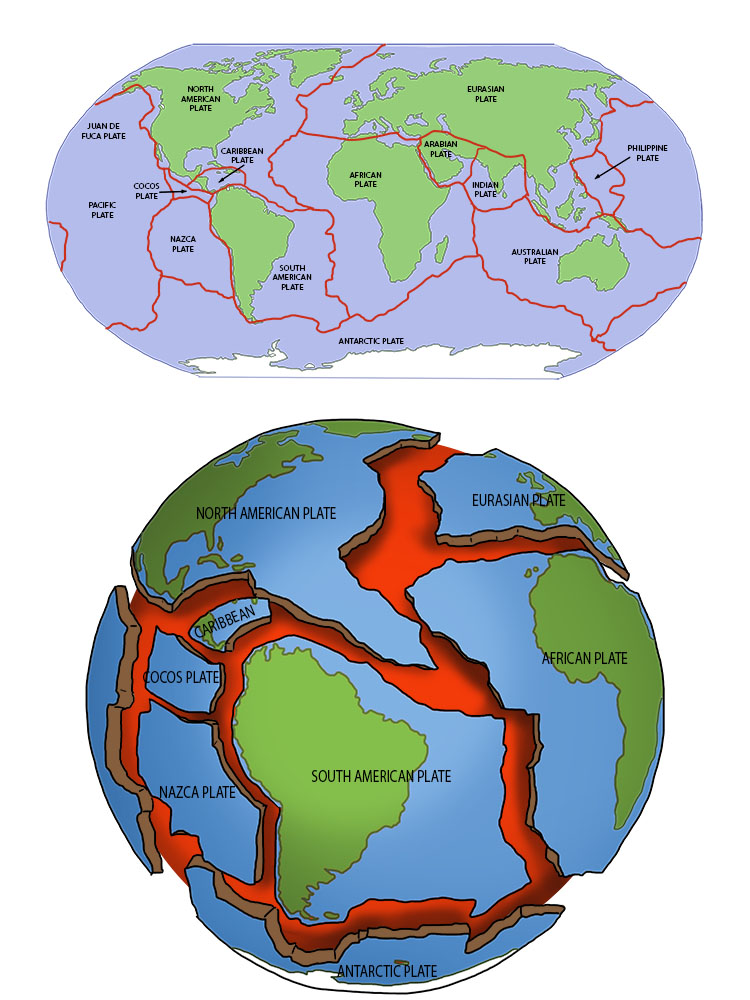
Tectonic plates are separations in the Earth’s mantle that divide the crust into large, continent-sized pieces. The tectonic plates are like jigsaw puzzle pieces fitted together to form Earth’s crust.
The tectonic plates are what helps release heat from the core and the mantle, and heat needs to be released for convection currents to happen in the Earth’s core. Convection currents are needed to move the liquid iron in Earth’s core to generate the magnetic field.
- In short, Earth’s magnetic field would be gone without its tectonic plates.
Also, Earth’s atmosphere was largely made of carbon dioxide, which is a potent greenhouse gas. The reason is because of intense volcanic activity during its early years. But to cool down the planet, somehow the excess carbon dioxide needed to be stored away safely into the Earth’s mantle. And tectonic plates are the exact mechanism Earth used to do that.
Over millions of years, rainwater causes CO2 to become carbonic acid. The carbonic acid hits the silicate rocks found in mountains, which causes the rocks to break down and release calcium ions. The carbonic acid becomes bicarbonate, and both the calcium and bicarbonate ions become washed away until they reach the oceans. Eventually, the calcium and bicarbonate mix together in the ocean floor to become limestone.
When a continental plate collides with the oceanic plate, it creates a subduction zone where the oceanic plate sinks into the mantle (that is the definition of subduction) and locks away the carbon-rich limestone from the ocean floor into the mantle.
Some of the carbon dioxide that was locked away from tectonic plate subduction gets released back into the atmosphere through volcanoes, but the vast majority of the carbon is forever locked into the mantle. In fact, 99% of Earth’s carbon was safely stored away inside the Earth due to being buried by subduction due to tectonic plate activity.
If Earth had no tectonic plates, it would have ended up like Venus: extremely overheated, dry, dead, and with zero magnetic field. Since Venus had the same amount of carbon as Earth, but no tectonic plates, 99% of its carbon dioxide remained in its atmosphere, causing a runaway greenhouse effect that superheated the planet to such high temperatures that even lead melts on its surface.
Finely-Tuned Universe
The fine-tuning of the universe is a scientific observation which states that the fundamental constants that govern the universe can only exist within an extremely narrow set of parameters for life to still be able to exist in the universe.
There are several fundamental universal constants that have to stay just right for life to exist, including but not limited to: the masses of the subatomic particles, Planck’s constant, the universal gravitation constant, strong nuclear force, weak nuclear force, etc.
- Scientifically, nobody knows where those constants come from and what caused them to be perfectly pre-set since the birth of the universe, but they are just a given fact of life. The fine-tuning of the universe is a massive coincidence of nature. Wherever those fundamental constants came from, they allow for the right kind of physics necessary for it to even be possible for a planet to host life.
Interestingly, space itself is not just an empty vacuum of pure nothingness. Space and time combine to form a 4-Dimensional geometric shape known as spacetime.
- For any moving object, spacetime’s geometric shape causes distances between points A and B to shrink (length contraction) in the direction of motion, and increases the length of time it takes to travel from point A to point B (time dilation). This is done so that spacetime can always keep the speed of light unchanging, relative to all observers, whether moving or motionless.
- Additionally, another property of spacetime is that it curves in reaction to any object with mass, which is what causes objects in space to fall towards one another (gravity). It’s like if you put a massive bowling ball on a trampoline and the surface of that trampoline curves inward.
- If time was not built into the fabric of space, no events would have ever occurred. We would not have gravity either, since the property of gravity is largely due to curvature of the time component of the fabric of spacetime.
What caused spacetime to have this strange, but convenient 4D shape? Or did it just happen by pure coincidence and we are extremely lucky? What deeper physics do we not know about? Scientifically, these are questions we will never find out the answers to.
Conclusion
Perfect physics, great sun, perfect distance from the sun, perfect moon, great atmosphere, perfect tilt, awesome tectonic plates, perfect chemistry, all of these are the “coincidences” of nature that happened in Earth history to enable a liveable universe and a liveable planet.
So, count yourself extremely, extremely lucky to even be alive right now. And if you worship God, take some time to thank and express gratitude for it.
If you are a Muslim and you open the Quran, something you might see frequently is references to naturally occurring phenomena such as the formation of the moon and the sun, the mountains, the clouds, the wind that pushes the rainclouds, the revival of barren lands into lands teeming with life, all are stated to be among the signs of God.
- All of these are a byproducts of the very convenient “coincidences” discussed in this post that caused Earth to be liveable, so a Muslim can understand why the natural phenomena on Earth may serve as a sign indicating that this was God’s handiwork.
Leave a Reply