
Salaamun alaykum, dear readers!
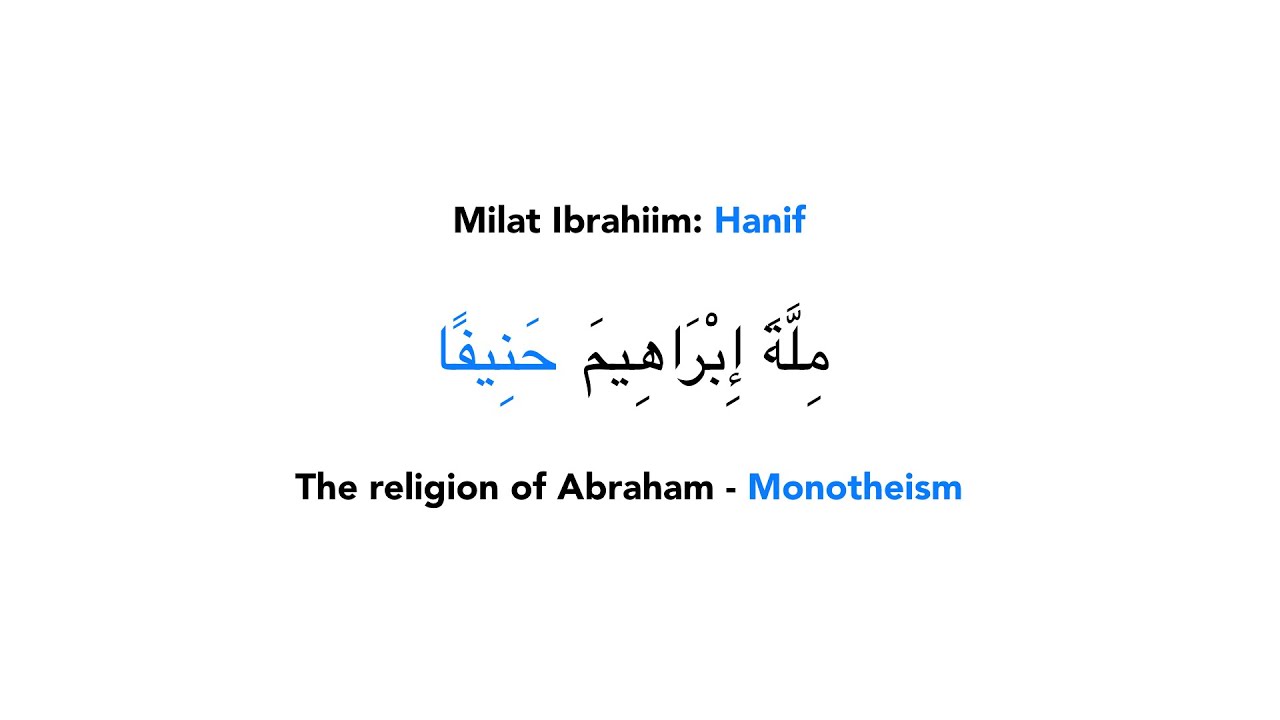
There is a command in the Quran to follow the ‘millat’ of Abraham. As a result, it has caused many of those who follow the Quran alone to conclude that it means to follow all the religious practices first given to Abraham.
This has led to people—including those who believe they are following the Quran alone—to authorize several rituals not found in the Quran, such as the 2.5% Zakat rate, the stoning of the devil during Hajj, and more.
Some people, including Rashad Khalifa, interpreted the term “millat” to mean a set of religious practices, thus causing the belief that following the “millat of Abraham” authorizes following the details of certain rituals (namely Salat, Zakat, and Hajj) according to how Abraham followed it.
However, to follow the Quran alone is to follow the Quran alone. Relying on something outside the Quran to supplement the details found in the Quran for the method of doing the Salat, Zakat, and Hajj is the opposite of following the Quran alone.
So with all the due respect that the very human and not infallible Messenger of the Covenant should receive, he is wrong in his position on this issue. This has caused him and others to adopt the position of a 2.5% Zakat rate, and a handful of other practices that are not mentioned in the Quran.
Issue #1: Lack of Historical Proof
To begin with, if one argues that Muslims are bound by the specific practices of Abraham, they must provide conclusive proof that such practices were perfectly preserved somewhere.
That is an impossible task because there is no historical proof whatsoever that Abraham gave 2.5% Zakat. No documentation of the specific way he was instructed to do any of the pillars of Islam currently exists anywhere in the world.
Since God does not assign any self except its capacity (verse 2:286), He does not assign anyone the burden of following the worship rituals of Abraham when we cannot even reliably verify the specifics of what Abraham was given (such as how many daily Salat, how much to give to Zakat, and more).
Issue #2: The Definition of Millat
Secondly, it is correct that the term “millat” in Arabic is synonymous with the term “deen” (which means religion and way of life).
Like all the prophets before and after him, Abraham followed and worshipped God alone, thus his millat, or religion, is Islam (which is the Arabic word for submission).
But that does not mean all prophets of Islam were given the exact same rituals.
The Jewish prophets Moses, Jesus, and others followed Abraham’s millat because they submitted themselves to God alone and followed what God gave them. But does that mean they were given Abraham’s specific religious practices? Of course not.
Abraham wasn’t given the Sabbath for example, this was given to Moses. But Moses is a follower of the millat (religion) of Abraham, which is the religion of Islam.
Joseph himself followed the “millat” (religion) of Abraham in verse 12:37, but he was given religious practices distinct for the Children of Israel, not Abraham’s full religious practices.
Verse 3:93 states that before the Torah was sent down, all food was lawful for the Israelites except what Israel prohibited on himself, and that applies to Joseph as he was Israel’s (Jacob’s) direct descendant. Joseph’s dietary prohibitions didn’t come from Abraham despite Joseph in Surah 12 claiming to be a follower of the millat of Abraham, thus indicating that millat refers to Islam itself, independent of the specifics of the Salat and the Zakat that were given to specific prophets.
Therefore, the command to follow the “millat of Abraham” is not a command to follow the specific way that Abraham performed Salat or gave Zakat, but a command to be a Muslim.
This is further supported by verse 6:161, which calls the millat of Abraham the “correct religion”. Obviously, the correct religion according to the Quran is Islam, therefore the “millat of Abraham” refers specifically to the religion of Islam and not the specific way that Abraham was supposed to practice the five pillars.
- [6:161] Say, “Indeed, my Lord has guided me to a straight path, an upright deen (religion), the millat (religion) of Abraham, one who is inclined to correctness. And he was not among the mushrikeen.”
- [12:38] “And I (Joseph) followed the millat of my fathers Abraham, Isaac, and Jacob. It has not been for us that we partner anything with God…”
Issue #3: Every Community Received Its Own System
The Quran places the final nail on the coffin by explaining that every community received a distinct set of laws and systems, and that every community is tested only according to what they specifically were given, as opposed to what past people are given.
Muhammad is only responsible for what God gave him, and only responsible to judge between the people by the Book that he was given, not the Book given to Abraham. And if we are to follow Muhammad, then we are not bound by the specifics in Abraham’s scripture either.
- [5:48] And We brought down to you the Book with the truth, a confirmer for what was before it of the Book, and one which is superior over it. So judge between them by what God has brought down, and do not follow their desires, away from what has come to you of the truth. For each of you, We have made a law and a system. And if God willed, He would have made you a single community, but instead, it is for that He may test you regarding what He has given you…
Conclusion: Rashad’s Duties As Messenger
Rashad lists several duties that he was assigned as Messenger of the Covenant (as listed in Appendix 2 of his translation), such as explaining how to do the Salat, or the Zakat, and other things.
But let’s focus on the Zakat for example. Rashad’s explanation of how to do the Zakat is only half-correct, because he says the Zakat is 2.5% taken out of any income or wealth one receives on the same day it is received.
- The 2.5% figure is not found or authorized in the Quran anywhere, and Rashad only assumed as such because of a misunderstanding of the command to follow the “millat of Abraham”.
- Thus, due to Rashad’s misunderstanding, he believed that the fixed rate of Zakat remained intact from Abraham up to now.
So why is Rashad’s explanation of the Zakat half-correct if it was one of his duties to explain how to do the Zakat?
That’s because Rashad’s list of duties as messenger at the end Appendix 2 does not mean God showed or revealed to Rashad the step-by-step method in how to fulfill these duties.
God didn’t send the angel Gabriel to say, “Hey Rashad, tell the people that Zakat rate is 2.5%.” God conveyed other information to Rashad through Gabriel, but not this.
Rather, Rashad himself stated that the duties God charged him with as the Messenger of the Covenant are all defined from verse 3:81.
In the footnote of his translation of verse 17:93, Rashad writes:
“Verse 3:81 defines the duties of God’s Messenger of the Covenant.“
Verse 3:81 charges the Messenger of the Covenant with confirming the authenticity Quran and all past scriptures beyond all doubts. That is the first duty contained in this verse.
The second duty in verse 3:81 comes from the fact that the Messenger of the Covenant will be coming after every single prophet. That means he is sent under the law of the final prophet (Muhammad). Since the law given to prophet Muhammad is the Quran, then the Messenger of the Covenant will be sent to teach the Quran and invite people to follow it.
So according to verse 3:81, it is Rashad’s duty to teach the Quran as best as he can. In fact, Rashad has said that in 1985, he was told by God to quit his job and devote his time to teaching the message (Quran).
- But this is not a guarantee that all of Rashad’s teachings are 100% correct. Rashad is documented to have acknowledged mistakes in his own work several times, and he has revised his own translation of the Quran three times for that purpose.
- Therefore, Rashad’s duty to teach the Quran is God-given, but Rashad’s attempt to carry out the duty to teach the Quran is imperfect (apart from conveying direct revelations).
- The only teachings from Rashad or any messenger that Muslims are required to unconditionally obey is revelation (verse 10:16, 7:203, etc.)
- Any teaching that is not revelation, but is from Rashad’s ijtihad (independent reasoning or personal understanding) should always be compared against the Quran to see if it is correct. If it does not align with what the Quran says, then that teaching should be ignored. This is what Rashad himself instructed to do.
To give another example, Muslims are told in the Quran to invite others to the path of God. It is a duty revealed by God to the believers. But this does not mean someone is protected from making mistakes while carrying out this duty; rather, people do their best, and some inevitably make mistakes while others do it near-perfectly.
- In other words, the God-given duty of a Muslim to invite others to Islam is Quranic and God-given, but the attempt to carry out that duty is not perfect.
- Likewise, Rashad having the duty to teach the Quran does not mean he is 100% protected from making mistakes while attempting to carry out this duty.
So how do you know whether something Rashad has taught is revelation or not? It is simple: he must explicitly say “God told/revealed to me this or that” or “I received this information from God” or “I was tasked with delivering this piece of information” or anything to that effect.
Gog and Magog
Rashad believed that because Gog and Magog are mentioned in verse 18:94 and verse 21:96, seventeen verses before the end of both Surahs, this is a clear sign from the Quran that Gog and Magog will reappear in 1700 AH.
In the footnote of verse 18:94, he writes, “One of my duties as God’s Messenger of the Covenant is to state that Gog and Magog, the final sign before the end of the world, will reappear in 2270 AD (1700 AH), just 10 years before the end.“
But during a Quranic study session on January 1990 (which was the month that he was killed), he says, “From the revelation of the Quran to the appearance of Gog and Magog is 17 centuries. Edip brought up the valid possibility that it may be 17 days before the end of the world, or 17 hours, 17 something. Obviously it’s not relevant to us. If it is relevant, God will let us know.“
So when Rashad says it is his “duty” to state that Gog and Magog will appear in 1700 AH, he is not saying this is what God told or revealed to him. He said God didn’t reveal anything to him about it and will do so if it is relevant.
Rather, when Rashad said it is his “duty” to say that Gog and Magog will appear in 1700 AH, what he really means is: he thinks this opinion is a truth supported by the Quran, so by stating this opinion, he assumed he was fulfilling his duty from verse 3:81 to teach the Quran.
In conclusion, if God revealed to Rashad something specific through Gabriel (such as the age of responsibility being 40) then Rashad clarifies that this piece of information came to him from God through Gabriel.
- Otherwise, everything else is Rashad’s own independent understanding or interpretation, which in Arabic is known as “ijtihad”, even if it is done while attempting to fulfill his duty in verse 3:81 to teach the Quran.
All the information that Rashad said he received as direct revelation from Gabriel to convey to the public is found in this link.
Leave a Reply