
Salaamun alaykum, dear readers!
The traditional understanding of a messenger according is one who receives a new scripture, and the traditional understanding of a prophet is one who receives any kind of message from God, whether it is a scripture or something else.
So according to the traditional school of thought, all messengers are prophets, but not all prophets are messengers.
But actually, the Quran says the exact opposite.
God in the Quran defines a prophet as someone who is given a scripture. Verse 3:81 says every single prophet took a covenant with God to deliver and preach the scriptures (kitab) they were given:
- [3:81] And when God took the covenant of the prophets: “Definitely, this is what I will give you of Book (kitab) and wisdom…”
In contrast, the Quran gives examples of messengers who were not given a scripture, which are the angel messengers sent to the mother of Jesus, as well as Lot and Abraham. So it is actually incorrect to say that all messengers receive a scripture or book from God.
The angel messengers warning Abraham of the destruction of Lot’s people and to inform of the birth of Isaac did not receive scripture from God. The angel messengers that came to Mary also didn’t receive scripture to convey to humanity, but gave one person (Mary) the message that she will bear a son as a virgin.
- [22:75] God chooses messengers from the angels, as well as from the people. Indeed, God is Hearing, Seeing.
- [29:31] And when Our (angel) messengers came to Abraham with the good news, they said, “Indeed, we are annihilators of the people of this town. Indeed, its people have been wrongdoers.”
So according to the Quran it is the reverse: all messengers simply deliver any kind of message from God, while all prophets are a specific kind of messenger who deliver a scripture from God.
- In other words, the Quran says the reverse of what Muslims today commonly believe: all prophets are messengers, but there are messengers who are not prophets and do not deliver any scripture. It’s very straightforward and clear.
Now someone might ask, “What about Aaron, the brother of Moses? He was a prophet, but he was not given a scripture, right?”
Yes, Moses was the one who directly received the Torah, but the Quran defines the official recipients as both Aaron and Moses, not Moses alone.
- [37:117] And We gave the two of them (Moses and Aaron) the clear Book.
- [21:48] And certainly, We definitely gave Moses and Aaron the Criterion, an illumination and a reminder for the servants.
So in retrospect, we now know why the Quran says that prophet Muhammad is the final prophet sent by God. The Quran’s logic is very consistent:
- If the Quran will be the final scripture,
- and if Muhammad was the prophet who delivered the Quran,
- and if a prophet is defined as one who delivers a scripture (verse 3:81),
- then it logically follows that there will be no prophets after Muhammad.
Messenger of the Covenant
So there is an interesting question to think about: is Muhammad the last messenger?
The answer is actually no, Muhammad is not the last messenger.
He is the final prophet, but we know he is not the last messenger.
The Quran states there will be a messenger who comes after the prophet Muhammad.
The messenger that has come to the people after prophet Muhammad will not be a prophet himself.
- Instead, he will be a messenger sent under the law of the Quran to convey certain messages from God, and to fulfill certain prophecies in the Quran that are waiting to be fulfilled before the end of the world.
Now, before we continue, I must warn you that if you are a Muslim, but you do not believe that the Quran alone must be followed, then you may not yet be ready to learn about the messenger whom the Quran said is coming after prophet Muhammad.
- That is because if you (like most Sunnis) believe that it is forbidden in Islam to go against ijma (the unanimous opinion of Islamic scholars), then when you see the Quranic verses informing of a messenger after Muhammad, you might try to twist the meaning of those verses to match the opinion of scholars, rather than accept the straightforward and clear meaning of those verses.
- So before learning about the messenger who came after prophet Muhammad, it is extremely helpful to know how the Quran itself tells the Muslims to follow the Quran alone as a source of Islamic law, and not to follow Hadiths, Sunnah, ijma, or anything else outside of the Quran.
- Moreover, I will let you know in advance that this messenger said God told him the straight path is following the Quran alone. So if you do not already have a solid conviction that Quran must be followed alone in Islam, then you will have a difficult time accepting and following this messenger.
- So before you continue any further, please visit this link for the full Quranic evidence that the Quran must be followed alone in Islam, without any secondary sources of religious law.
The Covenant
In verse 3:81, God gathered all the prophets and tells them that their mission will be to deliver the scriptures given to them. God then tells the prophets that afterwards, a certain messenger will one day in the future come to them, whose mission will be to confirm all of their scriptures.
- When this future messenger comes to meet them one day, all the prophets must pledge their faith and support in him. All prophets agreed to this and said yes.
- If God took this covenant from all prophets, then obviously God took this covenant from the prophet Muhammad too. That means the prophet Muhammad also pledged to support a future messenger who will come to meet him, whose mission it will be to confirm the Quran.
- [3:81] And when God took the covenant of the prophets: “Definitely, this is what I will give you of Book and wisdom. Then a messenger will come to you (all prophets, including Muhammad) as one who will confirm what is with you (the scriptures). Definitely, you (all prophets, including Muhammad) shall indeed believe in him and support him.” He said, “Have you agreed and accepted that, My heavy responsibility?” They (all prophets, including Muhammad) said, “We have agreed.” He said, “So bear witness, and I am with you among the witnesses.
The Quran also clarifies in verse 33:7 that the prophet Muhammad himself took this covenant alongside the other prophets, meaning he too agreed to support a future messenger (who will be tasked with the mission of confirming the Quran) who will one day come to him.
- [33:7] And when We took from the prophets their covenant—including from you (Muhammad), Noah, Abraham, Moses, and Jesus, the son of Mary—and We took from them a stern covenant.
Of course, how can a future messenger meet prophet Muhammad and the other prophets when all the prophets are long dead?
- Logically, this can only happen when God takes up the soul of this future messenger to somewhere in the afterlife to meet the prophets, kind of like prophet Muhammad’s “mi’raj” (ascension) to the place where the lote tree was.
After this future messenger meets all the prophets, his soul must be sent back down to earth so that he can complete his mission that is stated in verse 3:81 (confirming the scriptures that all the prophets were given).
Verse 7:35 Suggests Future Messengers
Another proof that Muhammad is not the last messenger is that the Quran says in verse 7:35, while talking to “the Children of Adam” (all human beings, present and future) that if His messengers come to us, telling us about God’s signs, then we should listen to those messengers.
- [7:35] O Children of Adam, if messengers among you come to you, narrating upon you My signs, whoever then reveres and reforms, there will thus be no fear upon them, nor will they grieve.
Let us suppose that King Salman was the last king of Saudi Arabia, and he makes this announcement: “Hello Saudi people, if kings come to you one day to rule Saudi Arabia, you should listen to them.”
- Why would Salman say that other Saudi kings may possibly come after him if he was really the final king?
Likewise, God in verse 7:35 tells prophet Muhammad to say to the people: if messengers among the people come to them with God’s signs, then they must listen to those messengers.
- The word “if” in verse 7:35 means an event can possibly happen.
So why would God discuss in the Quran the possibility that messengers may come in the future, if prophet Muhammad was truly the last messenger?
The reason is because the prophet Muhammad is really the final prophet, but not the last messenger.
God’s Warning
The Quran also tells us not to be like the people of Joseph, who kept mocking and ridiculing him as a liar and a crazy person even after the clear signs were shown to them, until when he died and they said there will never be another messenger to come after him.
- [40:34] And certainly, Joseph definitely came to you before with the clear proofs, but you had not ceased—in dissent from what he came to you with—until when he died. You said, “God will never raise up another messenger after him.” Like that, God sends astray whoever is an excessive doubter.
So God uses verse 40:34 to tell the people not to say that any messenger is the “last messenger” without evidence. This applies to the prophet Muhammad. God calls whoever does this kind of act an “excessive doubter”.
Quran Leaves Zero Room for Doubt
In short, the Quran is extremely clear on this issue and leaves zero room for doubt, saying that a messenger is for sure destined to come to the people after Muhammad. This messenger after Muhammad will be sent by God to provide the ultimate confirmation, or proof, of the Quran and all the scriptures before it.
All prophets agreed to believe in him and support him, according to verses 3:81 and 33:7, including Muhammad himself.
So if you think that you are a sincere believer and a Muslim, but you deny and reject the Messenger of the Covenant after being made aware of his existence from the Quran, and continue to falsely claim that prophet Muhammad was the final messenger, then you will no longer meet the Quranic definition of a believer.
- You will be considered a Muslim according to the definition in the Quran, but not a Mu’min (believer). Among the qualities of a true believer in the Quran is believing in all of God’s messengers (verse 2:286).
If you really consider yourself to be a true believer, then you should instead ask, “When will the Messenger of the Covenant arrive? What is the message for the people that God gave him? How can I support his mission?”
Identity of the Messenger of the Covenant
So who is the Messenger of the Covenant that will come after the prophet Muhammad, according to verse 3:81?
The Quran contains the every detail and explanation that is needed guidance and mercy.
- [12:111] … It (Quran) has not been a fabricated hadith, but instead, it is the confirmation of that which is before you, the detailing of everything, and a guidance and mercy for people who believe.
- [16:89] …And We have brought the Book down to you as a clarification for everything, as well as guidance, mercy, and good news for the Muslims.
- [7:52] And certainly, We have definitely come to them with a Book which We detailed with knowledge as a guidance and mercy for a people who believe.
Knowing the identity of this messenger is an important detail needed for guidance. If God didn’t leave behind any detail in the Quran to help the people identify who this messenger is, then the Quran would be incomplete and missing a very crucial detail, thus contradicting the three verses listed above.
Therefore, the Quran tells the believers exactly how to identify this messenger.
The two arguments from the Quran that confirms this messenger’s identity involves the Quran’s 19-based mathematical composition, which you can read about here.
The Quran’s First Argument
In the Quran, specifically verses 74:30 and 74:31, God stated that there are 19 angels who guard over Hell.
The Quran then stated God assigned “their number” (the number of the angels, which is the number 19) to do five functions:
- Be a trial for the disbelievers,
- Produce certainty in the hearts of the People of the Book (Jews/Christians),
- Increase the faith of the believers,
- Remove the doubt from the believers and the People of the Book.
- Cause disbelievers to deny the number 19 by asking, “What did God really mean by this example?”
Here are the verses in full:
- [74:30] Over it (the Fire) are nineteen.
- [74:31] We have made not but angels as custodians of the Fire, and We have not assigned “iddatahum” (their number, which is the number 19) except as: (1) a trial for those who have disbelieved, (2) so that those who were given the Book may attain certainty, (3) and that those who believed may increase in faith, (4) and that those given the Book—as well as the believers—may not doubt, (5) and that the ones who have sickness within their hearts—as well as the disbelievers—may say, “What did God mean by this example?” Like that, God sends astray whom He wills, and guides whom He wills; none knows the soldiers of your Lord except He. It is but a reminder for humanity.
These verses are saying that the number 19 will one day prove the Quran as the truth, beyond all doubt, causing many Jews, Christians, and Muslims to achieve certainty (yaqeen), increase their faith (iman), and remove the doubts from their hearts. The number 19 will also serve as a test for the disbelievers.
The question now becomes: in what way will the number 19 prove to the world that Islam is the truth?
How exactly will the number 19 will use to remove all doubt, increase faith and certainty of the believers, and test the disbelievers?
This information is part of the “ghayb (unseen)” because only God knows the answer.
And the Quran states that God alone is the knower of the unseen, but if He wants to make some of the unseen known, He will only make it known to whichever messenger he wants, then it will be the job of the chosen messenger to spread this information to the world.
- [72-26:27] The Knower of the Unseen, but He does not make His unseen obvious upon anyone except a messenger of whom He has approved…
Take the prophecy of the smoke in Surah 44, for example. Nobody knows what will cause the smoke to happen on Earth, so this information is unseen (ghayb).
- If God wanted the people to know in advance exactly how the smoke will happen, then He would have made this information known to a messenger first, then this messenger would have made it known to the world.
The same thing applies to the number 19, the exact way that the prophecy of number 19 found in verses 74:30-31 will be fulfilled is part of the unseen (ghayb). Nobody knew how the number 19 will remove doubts from the Jews, Christians, and Muslims, and increase their faith and certainty, and be a test for the disbelievers.
- And if God wanted this unseen information to be known to the people, He would only make it known to a messenger whom He chooses, according to verse 72:26-27. Then this messenger must convey that information to the public.
That means the “first knower” of the Quran’s 19-based mathematical structure (which will fulfill the Quran’s prophecy of 19) must be a messenger of God.
- The first knower of the 19-based mathematical structure is Rashad Khalifa.
- Therefore, Rashad Khalifa is a messenger of God.
Okay, we now know that Rashad is a messenger of God, but how do we know that he THE Messenger of the Covenant mentioned in verse 3:81?
- A messenger of God would not lie about being the Messenger of the Covenant, so if Rashad said that he was the messenger of the covenant from verse 3:81, then that is his identity.
- Rashad did in fact state that God told him how he is the messenger who fulfills verse 3:81, so we know for sure that Rashad is the messenger after Muhammad who is mentioned in verse 3:81.
The Quran’s Second Argument
The Quran in verse 3:81 stated that this messenger will confirm as the truth, beyond all doubts, the scriptures that were sent down to all prophets.
- That includes the Quran because the prophet Muhammad himself agreed to support the messenger of the covenant along with the other prophets (verse 33:7).
Okay, so the question is: how will the Messenger of the Covenant confirm the Quran and all past scriptures as the truth, beyond all doubts? How will we recognize the Messenger of the Covenant when he comes?
The Quran says it is fully detailed and complete (12:111, 16:89. 7:52, 6:115). Thus, such an important question is not left unanswered in the Quran. The answer must be in the Quran somewhere.
So if we look through the Quran, we find that verses 74:30-31 are the only details in the Quran that tell us how the Quran itself will be one day confirmed as the truth, beyond all doubts.
Therefore, if the Messenger of the Covenant will one day confirm the Quran as the truth, it will be by doing the actions mentioned in verses 74:30-31.
If you recall verses 74:30-31, it says that there are 19 angels who will be guardians of the Hellfire. It also says that “their number” (the number 19) was made by God as a tool to test the disbelievers, to bring certainty to the People of the Book (Jews and Christians), to increase the faith of the believers, and to remove all doubts from the hearts of both the believers and the People of the Book.
- If the number 19 did all of the things listed in verse 74:31, then the number 19 effectively confirmed the Quran and all previous scriptures as the truth, beyond all doubts.
So if verse 3:81 says that the Messenger of the Covenant will confirm the Quran and all previous scriptures as the truth, and if verse 74:31 states that the number 19 will be used to confirm the Quran as the truth beyond any doubt, then what does this tell us when we put 2 and 2 together?
- This tells us that the person who uses the number 19 to confirm the Quran and all past scriptures beyond a doubt is the Messenger of the Covenant.
- And who was the person to confirm the Quran as the truth from God with the number 19? That person is Rashad Khalifa.
Therefore, Rashad Khalifa is God’s Messenger of the Covenant, the one mentioned in verse 3:81.
Who is Rashad Khalifa?
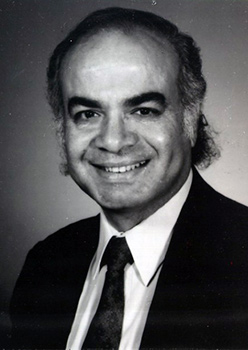
By all accounts, both public and private, he was a very nice guy. In fact, he is seemingly comfortable entrusting even his own car to strangers. Once, in the middle of a speech when certain audience members had to go to the airport, he offered his car keys and asked someone in the crowd to take his car and drive them to the airport.
Now, the interesting thing about the Messenger of the Covenant is that he is not a Sunni, although he used to be a Sunni until the late 1970s.
He was the vice president of the Islamic Center of Tucson, but according to one of his closest companions Edip Yuksel, he started being increasingly more skeptical of Hadith since the late 1970s. He was finally kicked out of the Islamic Center when he rejected the punishment of stoning adulterers to death that is found in Hadith, saying that it contradicts the Quran.
- After getting kicked out, Rashad established his own masjid in 1979, known as Masjid Tucson, which was dedicated to practicing Islam from the Quran alone.
Rashad said God informed him of his messengership during 1980, by which time he was no longer a Sunni.
- Rashad was informed by God in 1980 that he was a messenger on the straight path. Given that Rashad’s path during 1980 was following the Quran alone, God thus revealed through Rashad that the straight path is following the Quran alone.
Rashad’s Honesty
Being a messenger does not guarantee that someone will always be correct in their personal opinions, and this is evident throughout the Quran amongst many of them, ranging from Abraham, to Moses, to Jonah, and even Muhammad.
This is why Rashad frequently made the distinction between “Rashad the human” and “Rashad the messenger”, saying that like everyone else, “Rashad the human” is required to follow “Rashad the messenger” and will be held accountable for any deviation from the message that God sent to “Rashad the messenger”.
To give an example, one of Rashad Khalifa’s personal beliefs since at most 1985, which many might disagree about, is that Gog and Magog (Yajuj and Majuj in Arabic) will appear in 1700 AH.
Why does he believe this? He said that God and Magog appear in the Quran in verse 18:94, which is 17 verses before the end of Surah 18. Gog and Magog also appear in verse 21:96, which is also 17 verses before the end of Surah 21.
So he believed this is the Quran’s sign that Gog and Magog will appear in 17 centuries after the Quran’s revelation, or alternatively, in the year 1700 AH in the Islamic calendar.
And he could have easily said that this was information which God directly revealed to him through Gabriel, if he was dishonest. But he did not say that.
Here is what Rashad Khalifa said during a January 1990 Quranic study session, one of his last recorded study sessions before he was killed later in that month:
“From the revelation of the Quran to the appearance of Gog and Magog is 17 centuries. Edip brought up the valid possibility that it may be 17 days before the end of the world, or 17 hours, 17 something. Obviously, it’s not relevant to us. If it is relevant, God will let us know.“
So Rashad could have easily justified his personal belief by saying, “This is what God told me.” But in 1990, he honestly stated that God didn’t tell him anything about when Gog and Magog will come, and that maybe if it is important, God will reveal information to him about it.
Thus, he says the idea that Gog and Magog will appear in the year 1700 AH is his understanding of the Quran, rather than something God directly revealed to him.
This is definitely a sign of his honesty, showing that he was really a messenger, and that he is not trying to lie to the people about what he did or did not receive from God through the angel Gabriel.
Why Not Mirza or Joseph?
There are people who claimed to be prophets, such as former mayor Joseph Smith, Mirza Ghulam Ahmad, and others. Joseph founded the Mormon faith, and Ghulam Ahmad’s followers are known as Ahmadiyya Muslims. So why believe Rashad Khalifa and not them?
Well, the Quranic criteria of prophethood is that Muhammad is the final prophet. Mirza Ahmad claimed to be a prophet of Islam, hence he is disqualified.
The Quran’s definition of prophet in verse 3:81 is that all of them were given the “scripture and wisdom”, but Mirza Ghulam Ahmad claimed himself to be a prophet without a scripture, thus he is disqualified.
Another Quranic criterion is that prophets and messengers do not ask for payment from the people in return for what they do. This disqualifies Joseph Smith, whose written scripture requires the church to make sure he is financially taken care of due to his status as prophet.
Another Quranic criterion is that a messenger or prophet must preach the worship of God alone, which disqualifies Smith because, like Paul, he claimed himself to be a messenger sent by Jesus Christ.
Another key criterion is the one from verse 4:82, which states that something from God cannot have many contradictions in it. But there are many contradictions in the revelations that Joseph Smith and Mirza Ghulam Ahmad claimed was sent to them. Failed prophecies attributed to revelation count as a contradiction with history.
- Mirza wrote in his work Hammatul Bushra that, “I am not a prophet.” And in Izala Auham he wrote, “The door to prophethood is permanently closed. No new prophet can come.” But in other writings such as Tajalliyat-e-Ilahiya he said, “God has told me that I am a Prophet and a Messenger.“
- Mirza Ghulam Ahmad wrote in Tazkira that, “God revealed to me that Muhammadi Begum will definitely become my wife.” But this never actually happened.
- Mirza wrote in Hammatul Bushra that, “I will live for at least 80 years, as per divine revelation.” But he died at the age of 68, in year 1908, hence this is a contradiction with history.
- Joseph Smith said in his book Doctrines and Covenants section 114 that God said David W. Patten will go on a mission “next spring”. This prophecy was made in April 1838, but David W. Patten died in October of 1938, before next spring arrived. This is a contradiction with history.
- Joseph Smith, in volume 5 of History of the Church, prophesized in the name of God that if the U.S. government does not make amends for any of the wrongdoings it committed against Mormons, it will be overthrown and wasted in a few years, with nothing left of it. This, of course, never happened.
- In his book Doctrines and Covenants section 84, Joseph Smith said Jesus Christ revealed to him that a new city of New Jerusalem would be built in Missouri, with a new temple. But this city was never built because the Mormons were forced to flee Missouri due to persecution.
- In Doctrines and Covenants section 87, Joseph Smith said he received revelation that an American Civil War will begin at South Carolina between Northern and Southern states, and this Civil War will escalate to involve all nations on Earth. He prophesized that Great Britain will come to aid the Southern states. While the Civil War officially did begin in South Carolina years later, it never escalated to a conflict involving all nations, nor did Great Britain come to help the South.
Unlike Mirza Ghulam Ahmad, or Joseph Smith, Rashad Khalifa never once claimed himself to be a prophet.
Unlike Joseph Smith, Rashad Khalifa consistently and unrelentingly preached the worship of God alone.
Rashad also said, when he announced his messengership, that, “I am not a professional religionist. I will never let a single penny enter my personal pocket from religious activities, because then the motive changes.“
And lastly, the final criteria of all messengers in the Quran is that they have clear proofs backing them up. Mirza Ghulam Ahmad and Joseph Smith didn’t have any clear signs or proofs.
But Rashad Khalifa’s proof of messengership comes from the existence of the Quran’s 19-based structure, and verses 3:81, 33:7, 72:26-27, and 74:30-31.
Additionally, Appendix 2 and Appendix 26 of Rashad’s translation of the Quran (found in this link), he also provides the proof that his name has been mathematically encoded into the Quran by the 19-based system.
- Obviously, this is not needed to prove Rashad’s identity, but it provides additional or bonus confirmation.
Idolization of Rashad Khalifa Forbidden
Rashad Khalifa advised many times that obedience to the messenger is only obedience to his message, and not the messenger’s personal opinions or interpretations of the message. Rashad tells the people that while he is a messenger of God, it is their duty to disobey him if anything he says is not found in the Quran.
“We are not following Muhammad, we are not following Rashad Khalifa, we are not following any human being, and don’t let anybody tell you that. I don’t follow Rashad Khalifa, and you don’t follow Rashad Khalifa. We follow the words of God. We follow God, you and I.”
“And if Rashad Khalifa says anything on his own, we don’t listen to him. We can listen and use our own discretion. But we do not follow what Rashad is saying, we follow what God is saying, you and I.”
“You do not follow Rashad Khalifa. We do not follow Muhammad or Jesus. We do not follow any human being. We follow God, we know that.”
“And as you know, I’m the first one to tell you: if it is my opinion, if it is Rashad Khalifa, don’t follow him, because you’ll probably do the wrong thing. You must be sure you’re following God and following the word of God.”
“If I say anything that is not in the Quran, you tell me, ‘Get out of here.’”
“The criteria of obeying the messenger is: whatever he is saying must be in the Quran, must be backed up by what God is saying. If it’s not in the Quran, it is your obligation to disobey.”
“And we do not follow Rashad Khalifa or worship Rashad Khalifa, we follow what God says. If Rashad Khalifa says anything that is not in the Quran, you will be the first to tell him, ‘This is not in the Quran, why do you say that?’ And it is your duty not to obey him if it is not in the Quran.”
“We are going out of our way to destroy idols, not to make the idols. Our only god is God. And we have reached the conviction in our hearts that God alone possesses all power. We reached the conviction in our hearts that no saint, no prophet, no Muhammad, no Jesus, no Rashad Khalifa, no anybody, no one other than God can guide us.”
“We are people who know full well that no human being, certainly not Rashad Khalifa, can help you in anything except give you the message.”
“And we’ll go to any extent to make sure that we are following God and the word of God, and not following the words of any human being.”
“But we make it very clear, we follow Maalik al-Mulk, the Possessor of All Kingship. We follow only God. We follow only the word of God.”
The Covenant Fulfilled
Rashad states that the covenant discussed in verse 3:81 was fulfilled on Dhul-Hijjah 3, 1391 A.H. Rashad mentioned in a 1988 speech that during this day, his soul was taken up by God to some unknown place to meet the prophets.
Rashad was told at the time that this event is currently not something he should be concerned about right now, but it is something that had to be done.
Then, he was shown a group of people and was informed that those were all the prophets God sent. They then came to him one by one and silently nodded their heads to show approval, then Rashad was sent back to Earth. Here is how he describes the event in Appendix 2 of his translation of the Quran:
During my Hajj pilgrimage to Mecca, and before sunrise on Tuesday, Zul-Hijjah 3, 1391, December 21, 1971, I, Rashad Khalifa, the soul, the real person, not the body, was taken to some place in the universe where I was introduced to all the prophets as God’s Messenger of the Covenant. I was not informed of the details and true significance of this event until Ramadan 1408. What I witnessed, in sharp consciousness, was that I was sitting still, while the prophets, one by one, came towards me, looked at my face, then nodded their heads. God showed them to me as they had looked in this world, attired in their respective mode of dress. There was an atmosphere of great awe, joy, and respect. Except for Abraham, none of the prophets was identified to me. I knew that all the prophets were there, including Moses, Jesus, Muhammad, Aaron, David, Noah, and the rest. I believe that the reason for revealing Abraham’s identity was that I asked about him. I was taken aback by the strong resemblance he had with my own family – myself, my father, my uncles. It was the only time that I wondered, “Who is this prophet who looks like my relatives?” The answer came: “Abraham.” No language was spoken. All communication was done mentally.
That incident, which took place during my pilgrimage to Mecca, was the fulfillment of Verse 3:81. That incident took place while I was fully awake, and I have shared the details with my family, my family of believers, and with my friends.
It is worth clarifying that there is a slight inconsistency with the date. Dhul-Hijjah 3, 1391 in Mecca is actually Wednesday, January 19, 1972. But Rashad remembers that day in Mecca as a Tuesday as per his 1988 Conference speech, given that his favorite Quran reciter at the time (Mahmoud al-Banna) used to recite the Quran live on radio at Tuesday mornings, and given that he says this happened while he was listening to al-Banna in the morning with his brother.
He recalls bringing 100 cassette tapes with him to Hajj, and telling his brother Atef (who eventually came to believe Rashad’s messengership) on that day to record al-Banna’s recitals with them.
Thus, it is likely the actual date in Hijri calendar is Dhul-Hijjah 2, 1391, or Tuesday January 18, 1972.
Rashad has previously admitted he is often not good at remembering dates. In a 1989 Friday Khutbah, Rashad admitted that he only recently found out he unveiled the Quran’s 19-based structure in 1974. He said that his son repeatedly insisted Rashad discovered the Quran’s 19-based structure in 1974, but Rashad didn’t believe him and thought his son was maybe a few years off the mark. When Rashad went through his old records, he found that his son was indeed right, that Rashad first unveiled his discovery in January of 1974.
The meeting with the prophets that Rashad experienced in 1972 marked the start of Rashad’s messengership, because the covenant in 3:81 says that a messenger will come to all past prophets as one who will confirm all previous scriptures. If Rashad came to them in 1972, then that was the day Rashad officially became a messenger, although he not told by God of his messengership at the time why this event took place.
He was not yet aware of the 19-based mathematical composition of the Quran in 1972, nor was Rashad made aware that he was a messenger until 1980.
In fact, it was in 1968 that he first started to study the Quranic Initials, and he states in his newsletter that at the time that while the number 19 was frequently noticed during his study of Quranic initials, his main finding at the time regarding the Quranic initials (which he published in his 1973 book Miracle of the Quran: Significance of the Mysterious Alphabets) was that the letters of each initial occurred in the highest proportions in the Surahs that they occurred compared to other Surahs. Out of the 114 Surahs, there are only 29 of them with Quranic initials which nobody understood the purpose or significance of. Surah 50 is one of them, and it is initialed with the letter “Qaaf”. Rashad found that Surah 50 has the highest proportion of the letter Qaaf relative to other letters than does the other Surahs of the Quran, meaning it has the highest percentage of the occurrence of the letter Qaaf in its verses out of all Surahs, and it’s the same for every initial except Surah 36 (initialed with the letters “Ya” and “Seen”), which contained the lowest proportion of those two letters out of all Surahs.
It wasn’t until after he published the book in 1973 that he realized that maybe there’s something else that needs further research. He noticed a recurring pattern of 19 at the time when analyzing the Quran but didn’t think much of it when writing the book.
But as he re-examined the data after publishing that book in 1973, he realized that the letters of the Quranic initials seemed to occur in the initialed Surahs in multiples of 19, and then finally in January of 1974, the fact that a vast and complex 19-based mathematical system pervades the entire Quran became a reality to him.
So, January of 1974 should be one of the most significant dates in Islamic history to have occurred, because that is when the Messenger of the Covenant in verse 3:81 fulfilled the prophecy in verse 74:31.
Rashad also stated that even during the year 1980, while he was told that he was a messenger of God, he wasn’t told that he was the Messenger of the Covenant mentioned in verse 3:81. The explanation of verse 3:81 didn’t come to him until God told him in 1988, according to Rashad.
He stated, in his speech at a 1989 conference, that in 1980 he was approached by the angel Gabriel who informed him that he was a messenger. But Rashad thought it was Iblis, the devil/satan, and invoked God’s protection and refuge against the devil.
But after some back and forth discussion, Gabriel assured him that he was not Satan, and conveyed that Rashad was God’s messenger and that verse 3 of Surah Ya Seen is addressed directly to Rashad.
Afterward, Rashad resolved to just teach God’s message (the Quran), believing that there was no need to make the announcement, and fearing the ridicule and backlash he would receive even from his own friends and family whom he loved very much and wanted to be with in the Hereafter. He said, “I went on my merry way, saying I will preach the word of God alone.” So he never made a public announcement until 8 years later, in a Friday khutbah which was recorded on video at April 15, 1988, and is publicly available on YouTube.
He says in the October 1989 edition of his newsletter Muslim Perspective:
For eight years, I had maintained the same views as those who believe that an announcement was not necessary. I used to think: Why is the announcement necessary? Why not preach the word of God, uphold the word of God ALONE, and preach the worship of God ALONE, without announcing anything about the messengership? In those days of ignorance, I resisted making such an announcement. Finally, I was told that I was too coward to carry out the duties of God’s messenger. I was fired. It took a whole night of repenting, crying, apologizing, and pledging. When I reached a solid conviction that I must make the announcement, even at the cost of losing my own children and my best friends, I was restored. The following night, I spoke with my daughter during the pre-dawn meal of a Ramadan night, and I was trying to be as diplomatic as I could be. My daughter interrupted, “What are you trying to say, Dad? I knew all along that you are God’s messenger.” I received the same response from all the believers around me. They had known me for a long time, and they knew that I was not a crazy man. They realized that a person who lies about God or claims messengership falsely has to be a person who does not believe in God or the Hereafter; a person who does not expect to stand before God on the Day of Judgment to answer for his actions.
He stated that God accepted the repentance for his past 8 years of cowardice and restored his mission. He says in his May 1988 newsletter:
The recent announcement that I am God’s commissioned messenger to the world was NOT my idea. In fact, God Most Gracious has been immensely merciful towards me. Despite my cowardice for eight long years, God has accepted my repentance and my solemn pledge to (1) announce my identity as God’s messenger, and (2) never hesitate, hold back, or waver in declaring such identity. Thus, I can no longer afford to hesitate or be humble about this divine truth.
Rashad stated in a September 1988 conference speech that God told him about the covenant in verse 3:81, and how his meeting with the prophets that occurred many years ago was the fulfillment of that covenant.
The explanation he received from God in April 1988 was that when Rashad was taken by God to meet the prophets, God informed the prophets (who were in the afterlife) that the person standing before them is the one whom they all took a pledge to support before the creation, who will confirm all the scriptures they were given, and asked them if they approved of him.
Thus, when they all came to him one by one, nodding their heads, they were in fact expressing their support of Rashad in response to God’s question.
Fear of the Public
In fact, Rashad has told the story before about one example of his cowardice that occurred during a 1986 speech.
He said that he has long prayed that someone would not directly ask him, point-blank, if he were a messenger, because he would have admitted it and his secret would have gotten out. In the few occasions that someone asked him if he were a prophet, he would say no and respond that Muhammad was the last prophet. But no one asked him before if he was a messenger, and he wanted it to stay that way. He used to pray that no one asked him that question.
So after some heated back-and-forth discussion between Rashad Khalifa who was on the podium, and audience member Soussan Rey, she “let the cat out of the bag” and came to the conclusion that Rashad was a messenger of God.
Rashad suddenly went quiet after that, at a loss for how to answer. He said that Kathryn Kolton later told him that she noticed how quiet he was when Soussan asked him that. He said that what the audience didn’t know at the time was that he was praying very hard that no one would come to him afterward and ask him point-blank, to his face, because he would have said yes if that happened. Rashad’s lack of response caught the attention of many.
Rashad recalls Kathryn telling him that at the time, she overheard an audience member Ismail Barakat talking angrily amongst a couple people, saying he was determined to go ask Rashad after this event point-blank if he was a messenger. But to Rashad’s knowledge, Ismail did not ask him that question. So at some point during a speech, Rashad invited Ismail to the podium to explain why.
Ismail Barakat explained that the Quran-alone movement was supposed to be about destroying idols, not making new ones. Ismail recalled that in his understanding at the time, a messenger was someone who delivered a scripture. Rashad didn’t deliver any scripture to his knowledge, and if Rashad said he did, then he would be a confirmed liar. So he was very determined to confront Rashad point-blank and get a straight answer out of him.
But Ismail said, while swearing by God as his witness, that he was unable to open his mouth to ask Rashad that question. Rashad believes this was God answering his prayers at the time.
This shows that Rashad always avoided the topic of messengership like a flaming hot pack and never discussed anything about it, until he couldn’t hide it anymore in 1988.
Why Send a New Messenger If the Quran Is Complete?
Some people may question why God would want to send a new messenger if the Quran is already complete.
- The first reason is because as you have already seen, certain prophecies in the Quran (found in verse 3:81 and 74:31) required a messenger after Muhammad to fulfill them.
- The second reason is that if most Muslims are practicing and teaching Islam the wrong way, then it makes absolute sense for God to send a new messenger as a mercy to the people, to remind the people (and especially the Muslims) that the straight path is through the Quran alone, not through Quran and Hadiths.
Rashad’s Message
So, what is the message that the Messenger of the Covenant was sent with?
His first and primary mission given by God was to confirm the Quran and all previous scriptures of God as the truth from God, as stated in verse 3:81.
But how is he supposed to confirm the Quran and all previous scriptures? The Quran clarifies in verse 74:30-31 that the number 19 will cause Jews, Christians, and Muslims to increase their faith and their certainty, and remove the doubts from their hearts.
Such increase in faith and certainty, and the removal of doubt, can only happen if the number 19 confirmed and proved that the Quran is the truth from God. If the number 19 confirmed the Quran, then the number 19 also confirmed all other scriptures which came before the Quran (Gospel, Torah, the scriptures given to Abraham and David, and others).
Thus, Rashad’s main duty, as given by God in the Quran, is to confirm the Quran as the truth from God by using the number 19.
- The way Rashad fulfilled this duty is by teaching the Quran’s 19-based mathematical system.
Secondly, from the very beginning of his messengership, God sent him to teach and follow the Quran alone. In 1980, shortly after his 45th birthday, Rashad was approached by the angel Gabriel, who told him, “You are one of the messengers. Surah Ya Seen, 3, applies to you.“
Now, if anybody is familiar with Surah Ya Seen, they would know that verse 4 is a continuation of verse 3. The two verses, when combined, says:
- [36:3-4] Indeed, you are one of the messengers, on a straight path.
So altogether, God told Rashad through Gabriel that he is a messenger and on the straight path. That means the path that Rashad was following at the time (following the Quran alone) is the straight path.
If you tell a Sunni that you have stopped following Hadiths as a source of Islamic law, and that you now follow the Quran alone, he will accuse of you of being an apostate and abandoning the religion of Islam entirely. You will be told that you are not on the straight path. I know this from personal experience.
- Rashad himself was labelled an apostate by prominent Islamic scholars and was subsequently killed, which fulfills the requirement in Sunni Islam that apostates must be put to death.
But with this revelation, God was reassuring Rashad that he is not misguided, but rather, his current path at the time during 1980 (following the Quran alone) is the straight path, so he should keep following it.
- That means Rashad was ordered to continue following and teaching the straight path, which is the Quran alone. That was his second mission as God’s messenger.
The message of “Quran alone” is not a small message at all, even though it is just two short words. This is the single most important message that Rashad directly received.
- These two words are short, but heavy, due to the immense magnitude of theological and philosophical differences between Quran-alone Islam and the Sunni/Shia schools of thought. It is like a black hole the size of a penny. A black hole as tiny as this can actually fit inside it the weight of the entire Earth.
Another of Rashad’s responsibilities as messenger that was mentioned in the Quran is to convey the time that the world will end. To keep it very brief, the Quran said in verse 20:15 that God will “almost hide” the Hour (which is the time or moment that the world will end). That means the timing is not fully hidden, but is partially hidden, and the information is available somewhere.
- If God did not intend for the people to know this information one day, He would make this information fully hidden, not almost hidden. The fact that the Hour is almost hidden, rather than fully hidden, means the information is out there somewhere, and God wills for the people to someday find out this information.
- It’s like when someone buries some treasure, then leaves behind clues (such as a treasure map) and hints about the location of the treasure to help others find it someday; the location of the treasure is almost hidden, or partially hidden, and not fully hidden.
- The Quran is complete and not missing any detail (verses 12:111, 6:115, 16:89, and 7:52), hence the clues about the timing of the end of the world is somewhere in the Quran.
- The Hour is “unseen” (ghayb) information, and verse 72:26-27 says that God only makes known unseen information to a messenger whom He chooses. So a messenger of God must be the one who finds out this information from the Quran and unveils it to the public.
- Prophet Muhammad was not permitted to know the timing of the Hour (verse 7:187). But Rashad is the only other messenger mentioned in the Quran (verse 3:81) after prophet Muhammad, so he must be the one to complete the task of unveiling the time the world will end.
- Shortly before God informed him of his messengership, Rashad found out in the year 1980 that the world will end in year 1700 AH, or 2280 AD. He discovered this from the information contained in verse 15:87. Further explanation is given in this link.
Beyond that, here are some additional messages that God communicated to Rashad through the angel Gabriel:
- The command to announce his messengership in April 1988, and the temporary revocation of his status as messenger due to 8 years of cowardice, and subsequent forgiveness.
- The explanation of verse 3:81 that Rashad received in 1988 after he was restored to his position as messenger, that not only was he a messenger, but he is the Messenger of the Covenant mentioned in this verse. God explained to Rashad that his meeting with the prophets in Heaven many years before was the fulfillment of the covenant in 3:81 about the messenger destined to confirm all of God’s scriptures.
- The proclamation that all who die before age 40 will go to Heaven (the Quranic evidence of this, verse 46:15, is discussed here). Rashad said in Appendix 32 and in a Quranic study session that he was tasked by God to deliver this piece of information.
- The message that after Rashad dies, millions of believers will know that he is the Messenger of the Covenant, who represents the Messiah the Jews are waiting for, the second coming of Christ that the Christians anticipate, and the Mahdi that Muslims anticipate. This does not mean he is all three of these people. Rather, it means he is neither the Mahdi, nor the Christ, nor the Messiah, but was sent by God before the end of the world instead of those three.
- Rashad received a message from God, who stated that like the time of Noah, those who refuse to stand with God’s Messenger of the Covenant will be destroyed.
- A “new proclamation” from God that Rashad received, instructing people of all religions to “Purify, unify, consolidate your religions into one,” and instructing people of all religions to forget all idols and devote themselves totally to God alone to attain salvation. This message is discussed in depth here.
- Shortly before he learned of his mother’s death in Egypt, Rashad was informed that the righteous people do not experience death, but they go straight to Paradise.
Quranic Verses Referring to Rashad Khalifa
Throughout Rashad’s translation of the Quran, he points out a number of verses in the Quran which God told him is either directly talking to Rashad himself, or the messenger mentioned in those verses in the 3rd person point of view is Rashad.
Those verses specifically are: Verses 98:2, 81:19-24, 72:1-28, 61:9, 48:28, 46:35, 44:13, 43:43, 42:24, 41:43, 36:3, 35:24, 34:28, 34:43, 34:46, 28:44, 26:214-223, 25:27-30 (Rashad said this refers to Muhammad too), 25:56, 24:62, 22:49, 13:38, 13:30, 9:33, 5:19, 3:81, 2:252, and 2:119.
Some people may have a difficult time accepting that such verses are either directly addressing Rashad or talking about Rashad. The traditional interpretation is that each of the aforementioned verses refer to Muhammad only, but Rashad stated in multiple Quranic study audios that while he is always embarrassed to say things like that, it’s not his personal opinion and that he cannot afford to be ashamed, shy, or modest about admitting something like that.
When discussing Surah 72 and what Rashad was told from God, he stated that the group of jinns who heard the Quran in this Surah refer to a group who walked by his masjid (Masjid Tucson) and heard the Quran there. These were formerly Christian jinns who used to believe God had a son and attributed other nonsense to God. After learning about how amazing the Quran is and its 19-based mathematical composition, they became believers and continued to attend the weekly Quran study sessions hosted by Rashad.
Here is what Rashad said, when discussing Surah 72 during a Quranic study session, after stating that nothing in the Surah is addressed directly to Muhammad, but rather, it is addressed to Rashad himself:
- “This is not my personal opinion. If this was my personal opinion, I’d be wrong. This is not my personal opinion.”
- “I can’t afford to be embarrassed or ashamed or shy or modest.”
- “And when I tell you this, either I’m a very, very bad person, or I’m really a messenger of God. Because nobody will fabricate lies against God and attribute it to God in this flagrant manner, unless he’s really, really a disbeliever who doesn’t think he will face God one day on the Day of Judgement. So take your pick, there are only two extremes here: either a very bad person who claims to be receiving information from God, or a true messenger of God.”
Rashad used similar words in Quranic study audio number 31, when discussing how verses 81:19-24 refer to himself, saying that, “This is, of course, very embarrassing to me, but I can’t afford to hold back any of this. It’s mainly for the future generations. Our generation may not be able to withstand this kind of news.”
- He also said, “If you find that this is not acceptable, I don’t blame you. This is very difficult to accept.”
Rashad Khalifa Has the Same Imperfections as Prophet Muhammad
While Rashad Khalifa was a great human being in general, he possesses many of the same imperfections and flaws in his character that the prophet Muhammad possessed.
In short, Rashad the man is different from Rashad the messenger. And the truth is that Rashad the man has made some incorrect statements.
- Hence, this is why a Muslim should never idolize any human being like he is some perfect saint who never makes a mistake, even if that human being is a messenger.
In 1985, Rashad has made a number of guesses about the future, such as King Fahd being the last Saudi king, in response to someone from the Saudi elite class attempting to bribe Rashad with money, and because of the Saudi Arabia’s rejection of Rashad’s invitation to follow Quran alone and very basic facts involving the Quran’s 19-based mathematical composition, and other transgressions they have committed to try to stop people from knowing about the 19-based mathematical composition.
- I recall a Quranic study video in which Rashad said he wrote a book called “The Perpetual Miracle of Muhammad” to teach about the Quran’s 19-based miracle, but a group from Saudi once forced his book to be sold out, then burned away all the copies of the book they purchased, even though he made sure to put “miracle of Muhammad” in the title.
Because of such actions by the Saudis, Rashad believed this was like declaring war on God Himself, thus he predicted God will make Fahd the final Saudi king as part of the punishment for the Saudis.
He didn’t say such a prediction was made based on special knowledge of the future, but the prediction was based on the “word of God” (Quran).
- “Based on the word of God, that He forsakes those who forsake Him, and humiliates those who declare war on Him, I herein predict that Fahd shall be the FINAL SAUDI KING.” (Muslim Perspective, May 1985)
- Of course, Fahd was not actually the final Saudi king.
Rashad also predicted that if the governments throughout the Middle East (such as Iran and Saudi Arabia) mock and scoff at his official invitation to them to be part of his proposed “United Islamic Nation” (a worldwide “ummah” or community of people dedicated to following and teaching the Quran alone, of which every Quran-alone Muslim is automatically a member), then their governments will fall because the Quran in 11:38-39 says that God will mock those who mock Him, and give them a painful retribution, and verse 17:81 says falsehood will vanish and be replaced with the truth, and because 3:26 states that God grants and takes away sovereignty from whoever He wills. (Muslim Perspective, September 1985).
- Rashad also predicted, based on verse 9:126, that if governments whom he invited to be a part of the United Islamic Nation rejected his offer, they will be replaced, and fall at a rate of three governments every two years.
So Rashad has made several predictions, not based on divine revelation, but based on his flawed understanding of the Quran, which did not come true (such as Fahd being the last Saudi king).
This is an unfortunate character flaw that even the prophet Muhammad had too.
- In Sahih Muslim number 2897, if this Hadith is assumed to be authentic, the prophet Muhammad predicted that the Roman Empire will have a battle with an army from Medina in the Syrian towns al-Amaq and Dabiq. He predicted that 1/3 of the Medinan army will then proceed to conquer Constantinople from Rome.
- Of course, this is a false prediction because there was no battle in recorded history between a Medinan army and Romans in Amaq and Dabiq, and because Constantinople was conquered in 1453 by an army from Anatolia (modern-day Turkey), not an army from Medina.
Like prophet Muhammad in verse 33:37, Rashad too was reprimanded by God for his cowardice. In Rashad’s case, he was rebuked for hiding his messengership for 8 years due to fear of the people.
Like prophet Muhammad in verse 66:1, Rashad at times (due to his personal understanding) made certain prohibitions that God did not prohibit (such as prohibiting women from leading Salat prayers in a mixed congregation).
Both messengers (Rashad and Muhammad), while possessing great character, were ultimately humans, with their own (sometimes overlapping) character flaws.
This is exactly why anything beyond whatever revelation Rashad was given to convey is his own understanding, and his own understanding or independent reasoning (known as ijtihad in Arabic) is not guaranteed perfection.
Just like prophet Muhammad’s own ijtihad was never guaranteed perfection. Rashad has said this numerous times, as shown in the section, “Idolization of Rashad Khalifa Forbidden“.
Rashad stated in a Quranic study audio that he accepts when others point out mistakes he made, and sometimes deliberately lets himself make mistakes. He says he does that because one of his jobs is to destroy the idols, and he wants people to understand that he is not perfect so they don’t idolize him.
- That means he doesn’t always double or triple check his statements for mistakes before saying them and doesn’t always put every thought that comes to his mind through a filter.
- So this is why only whatever Rashad specifically mentioned as revelation is actual revelation, and not his other statements beyond that.
The primary message that God sent to mankind through him is the command to follow the Quran alone, so he doesn’t want people blindly following his statements and actions without first verifying them with the Quran alone.
Reaction to Rashad
35 years after his assassination, Rashad’s legacy lives on amongst those who have believed in him and followed him.
Unfortunately, he continues to be slandered as a crazy person who claimed to be a prophet, in spite of the sheer number of times that Rashad denied prophethood.
The Quran in Surah 2 highlights a striking similarity between the Jews during Muhammad’s time and the Sunnis during Rashad’s time.
Verse 87 said that whenever a messenger came to the Jews with what they didn’t like, they denied some and went as far as killing others.
- Likewise, Rashad came with the message of returning to Islam by the Quran alone, and his mission of confirming the past scriptures via the number 19 (which the Sunnis did not like), and for that, he was denied, targeted, and ultimately killed in January 1990. His own father tried to hire a man to assassinate Rashad, which failed at the time.
Verse 89 says that Jews in the past had certain prophecies in their past books that they were waiting to be fulfilled, so that it can evidence that their books were correct; but when another book came to them in the future that contained what they recognized from their past books (such as prophecies being fulfilled) they disbelieved in it. One example is that the Messiah (Jesus) is prophesized in the Torah, and the Jews constantly wait for the Messiah even today to prove that Judaism is the truth. But when Jesus came to them, a group of Jews disbelieved in him and had him killed.
- Similarly to the Jews in verse 89, the Sunnis during Rashad’s time and even today hope for Islam to be victorious over all other religions, and hope that it will one day be proven to the world as the truth.
- But when Rashad was sent to them to convey the Quran’s ultimate proof (the 19-based mathematical composition) in fulfillment of the prophecy in verse 3:81, and to correct their religious practices and teachings, they disbelieved in him and assassinated him,
Verse 91 criticizes the Jews for believing in their own books while disbelieving what came afterward; likewise, we Muslims have believed in the Quran, but disbelieve in what the Quran said was coming afterward (the Messenger of the Covenant).
- [2:87] … But is it not that whenever a messenger came to you with what yourselves did not desire, you were arrogant? You thus denied one group and kill another group.
- [2:89] And when a (new) Book came to them from God, a confirmer for what was with them (their past scriptures), while they used to seek victory over the disbelievers before. But when what they recognized (from the past scripture) came to them (by newer scriptures and messengers), they disbelieved it (the new scriptures). Thus, God’s curse is on the disbelievers.
- [2:91] And when it was said to them, “Believe in what God has brought down,” they said, “We believe in what was brought down upon us.” But they disbelieve in what is after it, while it is the truth, a confirmer for what is with them…
Conclusion: The Killing of Rashad
In February 1989, the Islamic Council of Fiqh (IFC) held their 11th conference in Mecca. The leading voice of that conference was Abdul-Aziz ibn Baz, who would become Arabia’s Grand Mufti 4 years later. The council issued a declaration labelling Rashad Khalifa as “apostate”, thus possibly setting the stage for his murder.
In Sunni Islam, apostasy (a Muslim becoming a non-Muslim) is punishable by death because it is one of the three valid reasons to take the life of a Muslim. So by rejecting Hadiths and Sunna, and declaring his messengership, Rashad met one of the three criteria for death in Sunni Islam.
- Abdullah ibn Masud reported Allah’s Messenger as saying, “It is not permissible to take the life of a Muslim who bears testimony to the fact that there is no god but Allah, and I am the Messenger of Allah, but in one of the three cases: the married adulterer, a life for a life, and those who leave his religion (Islam), abandoning the community.” (Sahih Muslim, No. 1676)
Since then, the death threats against Rashad intensified, both verbal and written. Investigators in 1989 uncovered a four-page murder plan found in a storage locker to assassinate Rashad Khalifa, written by members of the terrorist group Jamaat ul-Fuqra.
The plan was to stab Rashad to death inside the masjid kitchen at night, and it said that the knife was chosen because it was the quietest possible murder method. Shooting Rashad was discussed as an alternative. There were also pictures of surveillance footage of the inside and outside of the masjid found in the locker along with the murder plan.
Rashad Khalifa was ultimately stabbed to death 29 times inside Masjid Tucson’s kitchen before sunrise on January 31st, 1990, by a Jamaat ul-Fuqra affiliate.
The assassination was done in a manner that is consistent with the written plan. The murder was “a carbon copy of the handwritten plan,” according to Colorado’s former assistant attorney general Doug Wamsley.
The image below shows Glen Francis, the Jamaat ul-Fuqra affiliate who assassinated Rashad Khalifa, and was subsequently arrested in 2009 after evading the police for 19 years:

Several other members of Jamaat ul-Fuqra, such as James Williams (who was the leader of al-Fuqra’s local branch in Denver, Colorado) were arrested for being involved in the conspiracy to murder Rashad.
So while justice has been served, it is now the responsibility of all Muslims to come together and unite under the core message that God sent Rashad to convey: The Quran, which must be followed alone, is confirmed as the truth from God by the number 19.
Additional Resources
Rashad Khalifa’s newsletters and his translation of the Quran (plus Appendices) can be found on the website of the masjid he founded:
This is a YouTube playlist of Rashad’s recorded group Quranic study sessions: (56) 01 Quran Study From Azhar 1 Sura 72;19 28 & Sura 73 By Kathryn Jinns 05 26 1989 – YouTube
- Some things that stand out from his Quranic study sessions is that they are very relaxed and informal, with frequent banter, and involve multiple people (including Rashad) freely talking and expressing their opinions and perspectives. These Quranic studies are not segregated by gender either, both men and women are sitting with one another, contributing equally, thereby highlighting the close relationship that Rashad had with his followers.
- Rashad did a weekly 2-page Quran study session at his masjid, although sometimes the study sessions were at other people’s houses. During some sessions, Rashad takes the role of the “teacher”, while at other times someone else is the teacher while Rashad and the rest of the members are the “students”.
- These Quranic study sessions, more than any other of his content, provide valuable insight into Rashad’s personality and history.
And here is a recommended YouTube playlist of various recorded speeches and Friday sermons from Rashad Khalifa: 01 What Life is All About & Who is GOD?
Leave a Reply