
Salamun alaykum, dear readers!
Sometimes, a Muslim career woman might feel guilty for working and earning money while her husband stays at home caring for the kids and tending to the house.
But actually, the Quran permits househusbands to exist only under certain conditions, and permits women to be the primary income earner if they choose. Therefore, she should not let herself feel guilty for pursuing a professional career and needing her husband to tend to the household responsibilities in her absence.
The erroneous idea that househusbands and professional career women are prohibited in Islam is based on verse 4:34, which tells men to be “qawamoon” (maintainers) over their spouses financially.
- [4:34] The men are the maintainers over the women by what God has favored some of them over some, including by what they have spent of their money…
What Does Being The Wife’s Financial Maintainer Mean?

So this verse is saying that men are supposed to be maintainers of their women by using their wealth and resources.
The term “qawamoon” is plural for “qawam” and is derived from the noun “qiyam” which means to stand.
So the job of a “qawam” is to keep something in good standing, or good condition.
To give an example, let’s say you have an open wound that requires regular cleaning and dressing. You have a wound care nurse assigned to you who is responsible for maintaining the good condition of the wound so that it can heal well.
The wound care nurse is the assigned “maintainer” (qawam) of your wound. But does that mean you are prohibited from cleaning and maintaining your own wound? Of course, that is not true. You can do as much self-maintenance of the wound as you want, and the wound care specialist or nurse must take care of whatever portion of the maintenance you don’t want to do.
- So if you don’t want to dress or clean your own wound, the wound care nurse does everything.
- If you want to clean and dress your wound for only 3 days of the week, the wound care nurse is responsible for doing for the remaining 4 days of the week.
- If you want to clean and dress your wound all the time, the wound care nurse doesn’t have to do anything unless necessary.
It’s the same with the responsibility of the husbands as the financial “qawamoon” (maintainer). She can contribute to the financial expenses as much as she wants, and the husband is duty-bound to cover the rest. The husbands being the “qawamoon“ is not a legal prohibition against the existence of career women, or the existence of wives who want to pay the majority of the expenses.
- So if she wants to contribute 50% of the household money, for example, the husband must contribute the remaining 50%.
- If she wants to contribute 80% of the household money, the husband must contribute the remaining 20%.
- If she wants to financially contribute 0% of her money to the household, the husband must contribute 100% of the money.
Evidently, we have seen that the Quran gave the woman the freedom to choose how much she wants to contribute financially, and the husband must cover whatever deficiency remains after she exercises her freedom of choice.
That means a Muslimah career woman who enjoys her work, but wants a househuband to take care of the kids and the household chores at home, should not allow society to make her feel guilty about being a career woman.
Nor should she let society make her believe that “all Muslim women are required to be housewives unless the household cannot survive on the husband’s income alone” because that is not true.
Nor should a Muslimah housewife allow society to make her feel like a loser for not having a job, because that is not true.
And money is not the only way for men to do the role of “qawamoon” and maintain a wife’s good condition. The Quran says that men are the maintainers “by what God favored some of them over some”, which is more than just money. That means the husband must use any resource that is available and needed, because God favored some people with more resources than others.
- Other resources use to support his wife are time, attention, and emotional support, medical or first aid support, a nice and relaxing massage, doing actvities together, etc.
Wife-Beating Is Absolutely Not Allowed

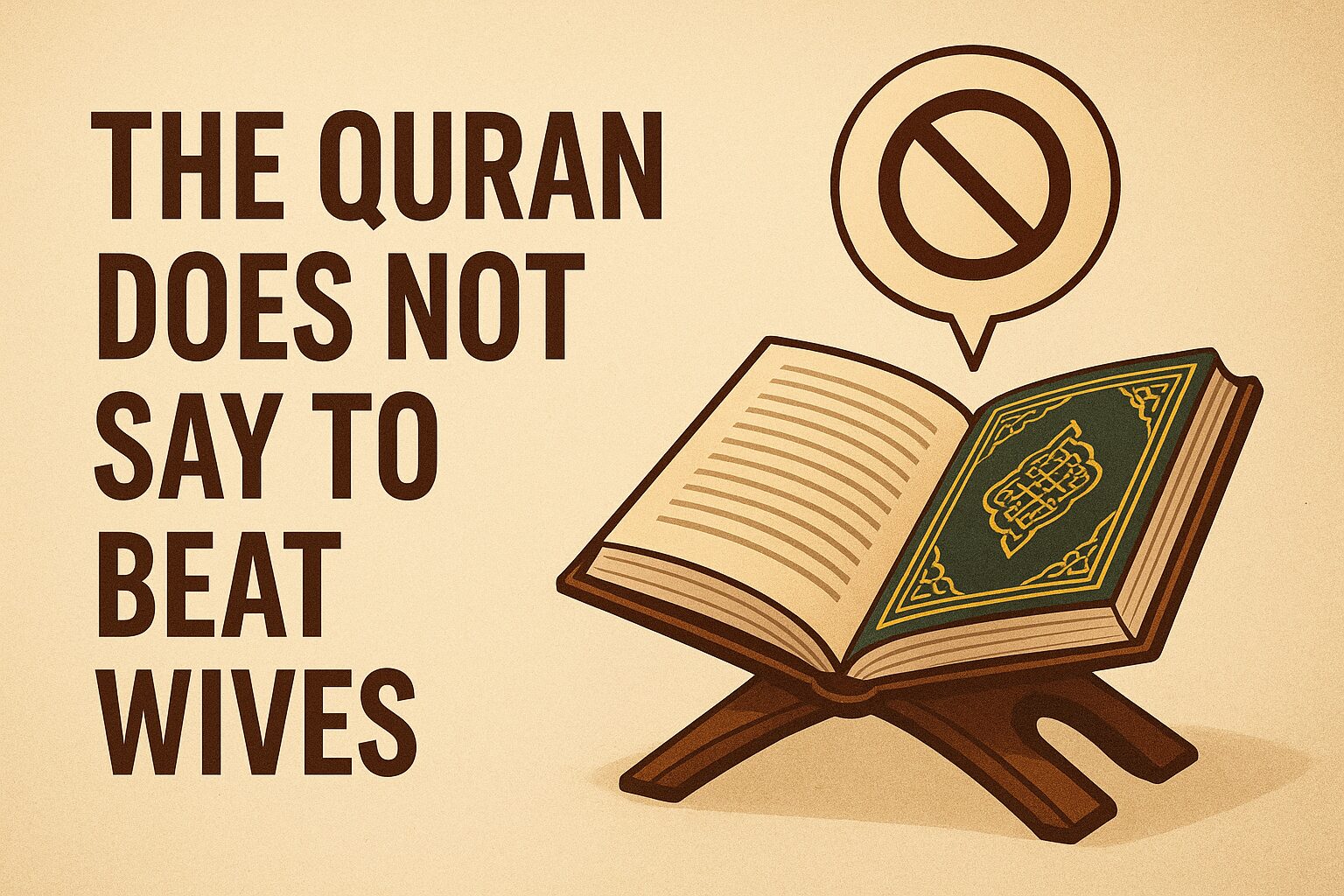
There is a false notion that the Quran allows wife-beating, but really that’s not true.
Many people mistranslate verse 4:34 to mean that the husband beats the wife, but that is untrue. The verse doesn’t really say to beat the wife, and it’s a mistranslation.
Let’s analyze this verse:
- [4:34] The men are the maintainers over the women by what God has favored some of them over some, including by what they spent of their money. Thus, the righteous women are devout guardians for the unseen, like how God has guarded. But the ones whose high-handedness you fear, you shall thus advise them, desert them in the bed, and “idrib” them. But if they obeyed you, then do not seek a way against them. Indeed, God is High, Great.
The word in contention here is “idrib”, and it the command form of “daraba” which is an Arabic word with multiple meanings. In the Quran, there are multiple meanings for the word.
The meanings are:
- Strike or beat (2:60-61, 3:112, 47:4),
- to present an example (43:57, 30:28, 13:17),
- to withdraw or separate (43:5),
- to seal or cover (18:11),
- to draw a piece of clothing over a part of the body (24:31),
- to attribute (43:17),
- to establish (57:13).
There are multiple-meaning words in English too. Just as professor Edip Yuksel said, “Many tried to ‘beat’ around the bush to ‘beat’ the problem generated by the word ‘beat’ of 4:34”.
Obviously, if any word has multiple meanings, context clues must be use to find out the correct meaning of the word. One cannot just assume “idrib” means to beat or strike if there is more than one meaning.
The word in 4:34 cannot mean “beating” for several reasons:
- If the verse commanded us to beat the wives, it would violate some Quranic principles. One is verse 2:187, which says that the spouses are like garments for each other (in that they warm each other with love and affection, among other ways), and wife-beating is absolutely contrary to this.
- We are told in verse 30:21 that affection and mercy should exist between the spouses, and beating is counterproductive to both.
- Also, we are told in verse 4:128 that reconciliation is the best option. How then can beating be allowed if it decreases the chance of reconciliation?
- The very next verse after this one (4:35) discusses what to do in case the couple fears a split between each other. We can therefore reasonably infer that the previous things mentioned in 4:34 were to calm things down, rather than inflame tensions by beating.
The only meaning that makes sense in the case of high-handedness is to separate/withdraw from them to give them space and let them calm down.
What Does Nushuz Mean? Are Women Supposed to Obey Their Husbands?
Some have said that verse 4:34 commands women to obey their husbands, because 4:34 discusses “nushuz” from a woman, which people interpret as disobedience. An ex-Muslim once argued with me that women in Islam cannot disobey their husbands because of the “nushuz” mentioned in verse 4:34.
But it cannot mean disobedience. Verse 4:128 talks about the husband committing nushuz towards the wife. So if the Arabic word nushuz meant disobedience, then who has the power in the relationship if both husbands and wives are able to commit nushuz? Does the wife disobey the husband, or does the husband disobey the wife?
Rather, the most commonly-understood (and correct) meaning of nushuz is high-handedness or behaving in an unreasonable, aggressive, domineering way.
And the way to deal with nushuz (high-handedness or domineering behavior) from the wives according to 4:34 is not to incite further aggression by beating them, but to separate from them until they have calmed down.
Leave a Reply