
According to the Quran, those who were given the Bible, or Book, were the ones who corrupted God’s Bible.
- [2:79] So woe to the ones who write the Book with their hands, then say, “This is from God,” for that they may exchange it for a cheap price. So woe to them for what they have written with their hands, and woe to them for what they earn.
- [3:187] And when God took the covenant of the ones who were given the Book, “Indeed, you must explain it for the people, and do not conceal it.” But they threw the Book behind their backs and exchanged it for a cheap price. Thus, wretched has been what they purchase.
The overall message of Christianity, depending on whether one takes the Protestant or Catholic interpretation, is that one must believe and worship Jesus, and/or live a righteous life by doing good deeds, in order to be admitted into God’s kingdom.
While Christianity presents a benevolent message that has touched the hearts of many, at the end of the day, beautiful words are not of much value if they are untrue words.
That is why one important question remains: how do we know whether the Bible is speaking the truth or not? What is the proof? Can the Bible pass the test of source criticism?
The Mystery of the Synoptic Gospels
According to current Biblical scholarship, the Gospels of Mark, Matthew, and Luke are known as the Synoptic Gospels.
That is because these three share such high amount of similarities that there is a high chance that the Gospels of Matthew and Luke copied the vast portion of their content directly from the Gospel of Mark, and from each other.
This graphic illustrates the relationship between the Synoptic Gospels:
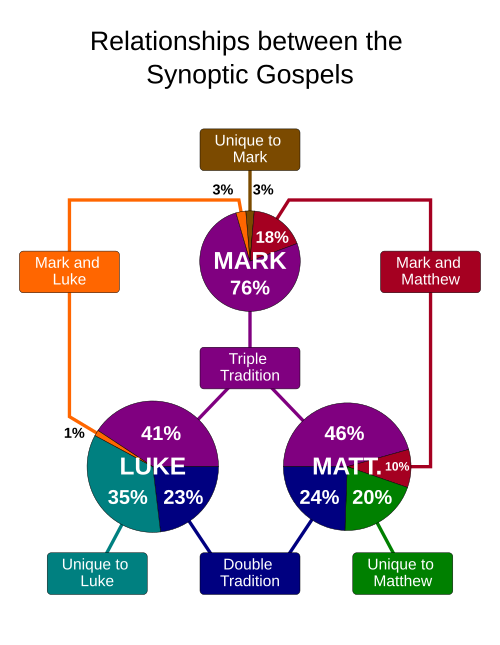
As you can see, the Gospels of Matthew have 20% of its content that is unique for it. The Gospel of Luke has 35% unique content only.
This diagram shows that the author of the Gospel of Luke copied 42% of its material from Mark, and the author of the Gospel of Matthew directly copied 56% of its content from the Gospel of Mark. 97% of the all the verses in Mark appear directly in either Luke or Matthew.
- This is not surprising, as the Gospel of Mark is the oldest gospel, as it is estimated to have been written in the year 70 CE. Whereas the Gospels of Matthew and Luke were estimated to have been written during 80-90 CE.
It also shows that 23-24% of the content of Luke and Matthew are exactly the same as each other but absent in Mark, and this is known as the “double tradition”. It is speculated that the authors of Luke and Matthew both copied the material found in the double tradition from an unknown “Q source”.
This mystery has been described as “the most fascinating literary enigma of all time“. It is traditionally assumed that the authors of all three Gospels wrote their books based on revelation from God, as these books are not true eyewitness accounts.
But if 65-80% of Matthew and Luke were directly copied from other sources, then it is questionable whether the authors of Matthew and Luke were truly writing down divinely inspired revelation or not.
Now the question is: did the author of the Gospel of Mark also copy and paste his information directly from an unknown source, like Luke and Matthew did? Or where did he get his information from?
And could the level of plagiarism in Matthew and Luke be the example of the type of “corruption” of the Bible that is mentioned in the Quran? It is a highly likely possibility.
The Gospel of John
The Gospel of John, which is the fourth and youngest Gospel in the New Testament Bible (being written in 90-100 CE), has about 90% of its content as unique. Hence, it is not labelled as one of the synoptic gospels. It is far easier to make the claim that the author of John was not plagiarizing its content.
In fact, it is also the only Gospel that gives insight as to who is the author, or where that person got his information from. It turns out that according to John 21:22-24, there was an unnamed disciple whom Jesus loved dearly, who passed down a set of teachings.
- These verses imply that he is dead by the time of the writing of this Gospel, and that others have passed down his teachings, until it reached the group of people who decided to record it all down into one narrative-style Gospel.
- Question remains as to who this unnamed disciple in John is, and did his teachings really get sent down without distortions, and what part of the Gospel of John is based on his original teachings and what part were later additions. But the Gospel of John provides at least some clarity.
Unlike the Gospel of John, the question of where the authors of the other gospels got their information remains a mystery. None of the Synoptic Gospels give any meaningful information about who their authors are, what their relationship to Jesus or his disciples was, where they got their information, whether this was based on direct revelation or just a combination of early Christian narratives, etc.
These concerns and red flags create challenges in determining the reliability or of the text, or whether we should really call the three Synoptic Gospels a foundational scripture of Christianity or not.
Contradictions
One of the criteria of divine authenticity is whether something, such as the Bible, has any contradictions or not.
Contradictions in the Bible, in this case, will not be defined as something that can be explained with knowledge of linguistics or semantics, or different Bible verses having part of the whole truth and adding context to each other. It would be unfair to cherry-pick the Bible in such manner.
When exploring whether there are contradictions in the Bible, the definition that will be used is two things that cannot in any way be true at the same time. Such contradictions, while not necessarily disproving divine origin, indicate at the very least that there have been man-made corruptions added to the divine message.
- In Matthew 27:5, Judas hung himself. But in Acts 1:18, Judas fell headfirst on an open field and burst open. Those are two contradictory deaths.
- There are two conflicting genealogies of Joseph, the adoptive father of Jesus, in Matthew 1 and Luke 3. Among the contradictions is that in Matthew 1, Joseph is descended from King Solomon, but in Luke 3 he is descended from Solomon’s brother Nathan. In Matthew 1, Joseph’s father is Jacob, but in Luke 3, Joseph’s father is Heli.
- In Mark 16:5 and Matthew 28:2-3, when Mary Magdalene and others went to see the tomb of Jesus, they encountered only one angel dressed in white. But in Luke 24:4 and John 20:12, they encountered two angels dressed in white.
- In Mark 15:25, Jesus was crucified at the third hour (9 AM) but in John 19:14 Jesus was crucified in the sixth hour (12 PM).
- In John 19:17, Jesus carried his own cross. However, in Matthew 27:32, Mark 15:21, and Luke 23:26, Simon of Cyrene carried it for Jesus.
- In John 20 and Mark 16, Jesus first appeared to Mary Magdalene alone during his resurrection. In Luke 24, he first appeared to two men (Cleopas and his companion). In Matthew 28 he appeared to Mary Magdalene and “the other Mary”.
- The Bible says there were two criminals crucified with Jesus. Matthew 27:44 says both criminals taunted Jesus. But Luke 22:39-43 says one criminal taunted Jesus while the other defended Jesus.
- Mark 5:21-24 says a synagogue leader named Jarius knelt before Jeesus and asked Jesus to place his hand on his very sick, dying daughter so that she may live. But Matthew 9:18-26 says Jarius asked Jesus to place his hand on his dead daughter so that she may live.
- According to Mark 10, James and John themselves asked Jesus to sit at his right and his left in his kingdom. But according to Matthew 20, it was the mother of James and John who made this request for her sons.
- According to Matthew 10:9-10 and Luke 9:3-5, the disciples were told to take nothing for their journey, not even a staff. But in Mark 6:8, Jesus told the disciples to take nothing for their journey, except a staff.
- Matthew 16:28 contains a false prophecy. In this verse, Jesus said some of those who were standing before him right now would not die before the second coming of Jesus. Obviously, this prophecy did not occur.
In Christianity, the New Testament is not supposed to contradict the Old Testament, if both are seen as equally divine scripture. But such contradictions exist, and here is a non-exhaustive list:
- The Torah says 70 people migrated to Egypt, including Jacob and his relatives (Deuteronomy 10:22) but the New Testament says 75 people did (Acts 7:14)
- The Torah says Jacob was buried in a cave in Hebron, purchased by Abraham from Ephron (Genesis 50:13) but the New Testament says he was buried in a cave in Shechem that Abraham purchased from Hamor (Acts 7:16). Shechem and Hebron are totally different cities.
- Matthew 2:23 says the prophets (in the Old Testament) said the Messiah will be from Nazareth, but there is no mention of Nazareth or Nazarene anywhere in the Old Testament.
- Matthew 1:23 quotes the Greek Septuagint version of Isaiah 7:14 as a prophecy about Jesus, which says that a virgin will give birth to a son. But the Greek Septuagint version is a mistranslation of the original Isaiah 7:14, which says a young woman (not a virgin) will give birth to a son. Isaiah 8 later identifies this young woman as Isaiah’s own wife (who is of course not a virgin), and the son as Isaiah’s own son.
- Matthew 2:6 misquotes Micah 5:2, saying Bethlehem is “not least” among the clans of Judah, but the original Micah 5:2 says Bethlehem is actually “small” among the clans of Judah.
- Mark 1:2-3 incorrectly attributes prophet Malachi’s words in Malachi 3 to the prophet Isaiah.
Hence, the presence of a large number factual contradictions that appear when scrutinizing the Gospels is another piece of evidence supporting the Quran’s claim that the Christians heavily corrupted God’s original Bible.
Scripture Alone? Or Scripture + Sacred Tradition?
The Bible sends contradictory messages regarding whether to follow the Bible alone as the source of Christian faith and law, or whether to follow the Bible and the “Sacred Tradition”.
Protestants believe in the doctrine of sola scriptura (scripture alone). This means the word of God as written in scripture is the only source of law.
But Catholics believe in following both scripture (the Bible) and the sacred tradition (the unwritten traditions passed down from the disciples). This is why the Catholic church has many teachings and doctrines not originally found in the Bible.
Both worldviews are contradictory yet supported by the Bible. For example, here is a Bible verse to support “scripture alone”.
- Now, brothers and sisters, I have applied these things to myself and Apollos for your benefit, so that you may learn from us the meaning of the saying, “Do not go beyond what is written.” Then you will not be puffed up in being a follower of one of us over against the other. (1 Corinthians 4:6)
And here is a Bible verse to support following both scripture and a sacred tradition:
- So then, brothers and sisters, stand firm and hold fast to the traditions we passed on to you, whether by word of mouth or by letter. (2 Thessalonians 2:15)
This is why the debate over both Catholicism and Protestantism is fierce on both sides, because both sides are Biblically supported.
Faith Alone, or Faith and Works?
It is well-known that the Bible presents mixed messaging in regard to whether faith alone is sufficient for salvation.
Sometimes the Bible sounds like a Protestant and has verses suggesting that faith alone is enough.
But at other times, the Bible sounds like a Muslim and says that faith alone is not enough, and that God will reward and punish people according to their deeds and labor.
This is why the Protestants believe that salvation is a free gift from God, and this is why Catholics believe faith and good deeds are necessary for salvation.
Such mixed messaging may be a sign of corruption of God’s original scripture, because all contradictions such as this come from human interference with divine scripture.
Faith Alone
In his epistles, such as Galatians or Romans, Paul teaches that people will be justified by their faith in Jesus alone, not by their works. Paul is very critical of Jewish law, calling it a curse that Jesus lifted from mankind after his crucifixion
- “This righteousness is given through faith in Jesus Christ to all who believe. There is no difference between Jew and Gentile, for all have sinned and fall short of the glory of God, and all are justified freely by his grace through the redemption that came by Christ Jesus. God presented Christ as a sacrifice of atonement, through the shedding of his blood—to be received by faith. He did this to demonstrate his righteousness, because in his forbearance he had left the sins committed beforehand unpunished— he did it to demonstrate his righteousness at the present time, so as to be just and the one who justifies those who have faith in Jesus.” (Romans 3:22-26)
- “Therefore no one will be declared righteous in God’s sight by the works of the law; rather, through the law we become conscious of our sin.” (Romans 3:20)
- “For all who rely on the works of the law are under a curse, as it is written: ‘Cursed is everyone who does not continue to do everything written in the Book of the Law.’” (Galatians 3:13)
Faith + Righteous Deeds
But at times, Paul and other authors of Bible scripture sound like Muslims, teaching that only believing in God and doing righteous deeds, and upholding His rules, will save people, and that people will be rewarded exactly according to their deeds.
- “Circumcision is nothing and uncircumcision is nothing. Keeping God’s commands is what counts.” 1 Corinthians 7:19
- “The one who plants and the one who waters have one purpose, and they will each be rewarded according to their own labor. For we are co-workers in God’s service; you are God’s field, God’s building.” (1 Corinthians 3:8-9)
- God “will repay each person according to what they have done.” To those who by persistence in doing good seek glory, honor and immortality, he will give eternal life, but for those who are self-seeking and who reject the truth and follow evil, there will be wrath and anger. There will be trouble and distress for every human being who does evil: first for the Jew, then for the Gentile; but glory, honor and peace for everyone who does good: first for the Jew, then for the Gentile. (Romans 2:6-10)
- “In the same way, faith by itself, if it is not accompanied by action, is dead.” (James 2:17)
- “Why do you ask me about what is good?” Jesus replied. “There is only One who is good. If you want to enter life, keep the commandments.” (Matthew 19:17)
- “Not everyone who says to me, ‘Lord, Lord,’ will enter the kingdom of heaven, but only the one who does the will of my Father who is in heaven.”(Matthew 7:21)
Matthew 7:21 is especially striking in that it rejects the whole idea that faith alone will save anyone, as it says not everyone who calls Jesus lord or has faith in Jesus will go to Heaven, but ONLY those who “do” the will of God goes to Heaven.
And the book of Matthew disagrees that the law is a curse and was made irrelevant. In Matthew 5:18-19, Jesus says not even a letter of Jewish law will disappear until everything is accomplished and the universe disappears, and that people who uphold the Jewish law will have the highest rank in God’s kingdom, and people who don’t will have the lowest rank.
- “For truly I tell you, until heaven and earth disappear, not the smallest letter, not the least stroke of a pen, will by any means disappear from the Law until everything is accomplished. Therefore, anyone who sets aside one of the least of these commands and teaches others accordingly will be called least in the kingdom of heaven, but whoever practices and teaches these commands will be called great in the kingdom of heaven.” (Matthew 5:18-19)
Harmonization
These various passages may be harmonized in certain ways to resolve the apparent contradiction here, such as: “Faith is the only thing that saves anyone and grants them Heaven, however, one’s faith will only be seen as sincere and acceptable in the eyes of God if backed up by doing good deeds and living a righteous life.”
One may also say, “Good deeds are an outward manifestation and consequence of true faith, and the more good works that a person does, the higher his or her faith will be valued, and the more rank he or she will have in the afterlife.”
This is exactly what Islam teaches by the way. The ones who will end up receiving the most rewards in the afterlife according to Islam are the “faithful” or the “believers” (al-mu’minoon in Arabic). Faith, or iman, is the foundational pillar of Islam, and is the thing that decides whether one goes to Hell or not.
- But faith alone, without doing good deeds is not acceptable by God in the Quran. Good deeds are a reflection and manifestation of sincere faith, hence God requires it. The more good works that a person does out of sincere faith, the stronger and more valuable that person’s faith is to God.
- Ultimately, what the Quran and the Bible have in common is that salvation is not truly a free gift to the believers; it must be earned by both faith and doing good deeds…
- ..,at least if we don’t count the Quran’s statement in verse 46:15 that a person has at most 40 years before he decides to live as a Muslim and declare his submission. Thus, a person who dies before age 40 will not be held accountable for lacking faith or being a non-believer, hence will be admitted to Heaven as an act of mercy according to the Quran. But this is the only instance in either of the two religions where salvation is actually unconditional.
Complete Replacement: The Most Extreme Corruption
The Old Testament is the first book of the Christian Bible. However, when we examine the volume of research involving this book, we reach a conclusion that is so startling, to the extent that it may signal an existential threat to the legitimacy of Christianity if widely known.
It turns out that the corruption of the Old Testament runs so deep that at some point in history the original Book of Moses was completely replaced by today’s Old Testament.
Imagine if, in the year 1000, the original Quran was replaced by a new Quran.
- In a similar way, modern scholarship concludes that the current Torah did not originate from Moses, but was written and edited long after him, originating during the Babylonian captivity of the Israelites in the 6th century BCE.
- As a result, many Bible scholars believe that there was never any such thing as a law of Moses, and that no Old Testament or Torah existed before King Josiah’s rule in 622 BCE.
In fact, the Elephantine Papyri, which are a collection of 5th century BCE documents from the Jewish community residing in the Egyptian Island of Elephantine, show that many Jews during that time were openly polytheistic and worshipping multiple gods (Yahweh, Anat, Bethel, Eshem-Bethel, etc). They seemed to have little to no knowledge that a Hebrew Bible existed.
To give one example, the papyri document a small Jewish temple at Elephantine, which is in clear violation of Torah law since the Torah only allows one temple at Jerusalem.
- Strikingly, the documents show that the Elephantine Jews openly petitioned the high priest of Jerusalem for support in rebuilding their temple at Elephantine, expressing pride at dedicating this temple to Yahweh.
- This indicates the Jews of Elephantine were not scared or concerned that the high priest of Jerusalem would see it as heretic and reject their request.
- So this is evidence that at the time, even as late as the 5th century BCE, the Torah or Old Testament was an incomplete and widely unknown document in Jewish communities. This is very similar to the concept of isolated Muslim communities who are worshipping Greek gods and have no awareness about the Quran.
Shockingly, the polytheism of the Jews during the creation of the current Torah reveals itself in Deuteronomy 32:8-9. Deuteronomy is one of the Torah books. Here, the Highest God, El Elyon, divided the nations among the many sons of God, and His son Yahweh was given the nation of Israel, who were descended from Jacob:
- “When the Most High God (El Elyon) gave the nations their inheritance, when he divided all mankind, he set the boundaries of the peoples according to the number of the sons of God. For Yahweh’s portion is his people, Jacob his allotted inheritance.” (Deuteronomy 32:8-9)
Later scribes changed the text “sons of God” to “sons of Israel” to avoid conflict with monotheism, but the original manuscript shows “sons of God”, thus accidentally revealing the polytheistic background of the creators of today’s Torah.
- The entire Jewish narrative is that Yahweh is the name of the one, eternal, almighty God, but Deuteronomy 32 indicated Yahweh is just one son of the Most High, among many others.
- If Moses truly existed, then something like this could not have originated from him.
Another key proof that the Torah that exists today cannot be the original law of Moses are the many anachronisms that appear in the Torah, such as the fact that Deuteronomy 34 describes the death of Moses. Moses himself could not have written about his own death.
- Anachronisms are events that appear in a literary text which could not have occurred during the time it was allegedly written.
Existential Threat to Christianity
The bombshell revelation that the current Torah is not the law of Moses, and that the Israelites were likely a polytheistic people until as late as the 5th or 4th century BCE, was actually known by scholars since the 1600-1800s, or even before.
Nonetheless, this fact may represent an existential threat to Christianity itself by threatening the foundation upon which the entire religion of Christianity rests.
The Christian faith requires believing the following things:
- Today’s Torah is the real Law of Moses given by God
- Jesus represents the “part 2” of today’s Torah
- The concept of inherited Original Sin in today’s Torah, and Jesus saving humanity from it with his sacrifice
All three of these are violated if today’s Torah and Old Testament did not come from God or the prophets at all, but was completely fabricated by later-generation Jews over many decades, starting from the 5th century BCE.
In fact, if you look throughout the New Testament, you see that Jesus, Paul, and others continually says that the current Torah really is the original Law of Moses given by God:
- Then Jesus said to him, “See that you don’t tell anyone. But go, show yourself to the priest and offer the gift Moses commanded (in Leviticus), as a testimony to them.” (Matthew 8:4)
- Some Pharisees came and tested him by asking, “Is it lawful for a man to divorce his wife?” “What did Moses command you?” he (Jesus) replied. They said, “Moses permitted a man to write a certificate of divorce and send her away.” “It was because your hearts were hard that Moses wrote you this law,” Jesus replied. (Mark 10:2-5)
- But about the resurrection of the dead—have you not read what God said to you (in Exodus 3:6): ‘I am the God of Abraham, the God of Isaac, and the God of Jacob’? He is not the God of the dead but of the living.” (Matthew 22:31-32)
- For the law of Moses has been preached in every city from the earliest times and is read in the synagogues on every Sabbath. (Acts 15:21)
- Moses writes this about the righteousness that is by the law: “The person who does these things will live by them.” (Romans 10:5)
- For it is written in the Law of Moses (Deuteronomy): “Do not muzzle an ox while it is treading out the grain.” Is it about oxen that God is concerned? (1 Corinthians 9:9)
So you can see how this news is devastating for Christianity, and even more devastating for Judaism.
If the Torah was not written by Moses and did not exist in its current form until long after him, then Jesus’s divine mission and teachings, Paul’s theology, and the entire New Testament lose their foundation and theological meaning.
- This is truly the most catastrophic discovery possible for both Judaism and Christianity.
Conclusion: Islam is Christianity’s Last Saving Grace
The Quranic narrative says:
- The entire Bible is the word of God, and today’s Bible has some divine truth in it, but it was severely corrupted
- The corruption likely started during Solomon’s reign, when witchcraft and sorcery became common practice (according to Quran’s verse 2:102).
- Jesus was the Jewish Messiah, God’s prophet and messenger, and worked miracles and taught the true Torah and Gospel.
- The Quran is the final criterion, helping us distinguish which parts of today’s Bible matches with what God originally sent down from which parts are human additions.
Hence, it can be hypothesized that the growth of occult practices like magic and superstition infiltrated Judaism during Solomon’s kingship, eventually transforming into widespread polytheism and the complete loss of Moses’ original Torah, which lasted until the creation of today’s Torah during the Babylonian exile.
And it’s not just the Quran, but many prophets after Moses in the Old Testament itself were sent because Israelites were worshipping idols such as Baal, and neglecting Torah law.
So it shouldn’t come as a huge surprise that today’s Torah is a complete fabrication, the victim of the most extreme form of corruption possible.
The Quran, while pointing out the corruption that took place in the past scriptures, clarifies that the current Torah and Gospel is a good enough approximation to the original Torah that Jews and Christians can and should continue to use it as a source of religion and law, even while accepting the Quran as the truth, while making sure to reject teachings in today’s Bible that the God from the Quran would certainly have never taught to the past prophets and messengers (such as the Trinity).
- [5:44] Indeed, We brought down the Torah, in which is guidance and light. The prophets who submitted to God judged with it for the ones who are Jews, including the Rabbis and the scholars, by what they were entrusted of the Book, while they were witnesses upon it. So do not fear the people, but fear me, and do not exchange my verses for a cheap price. And whoever does not judge by what God has brought down, then those are the disbelievers.
- [5:68] O People of the Book, you are not upon anything until you establish the Torah, the Injeel, and what was brought down to you from your Lord…
- [5:47] And let the People of the Injeel (Gospel) judge by what God has brought down in it. And whoever does not judge by what God has brought down, then those are the deviant.
So if Jesus, Moses, other Israelite prophets, and the Bible have any hope of legitimacy at all, it is through the Quran. In other words:
- If Islam collapses, it will take Judaism and Christianity down with it.
Leave a Reply